
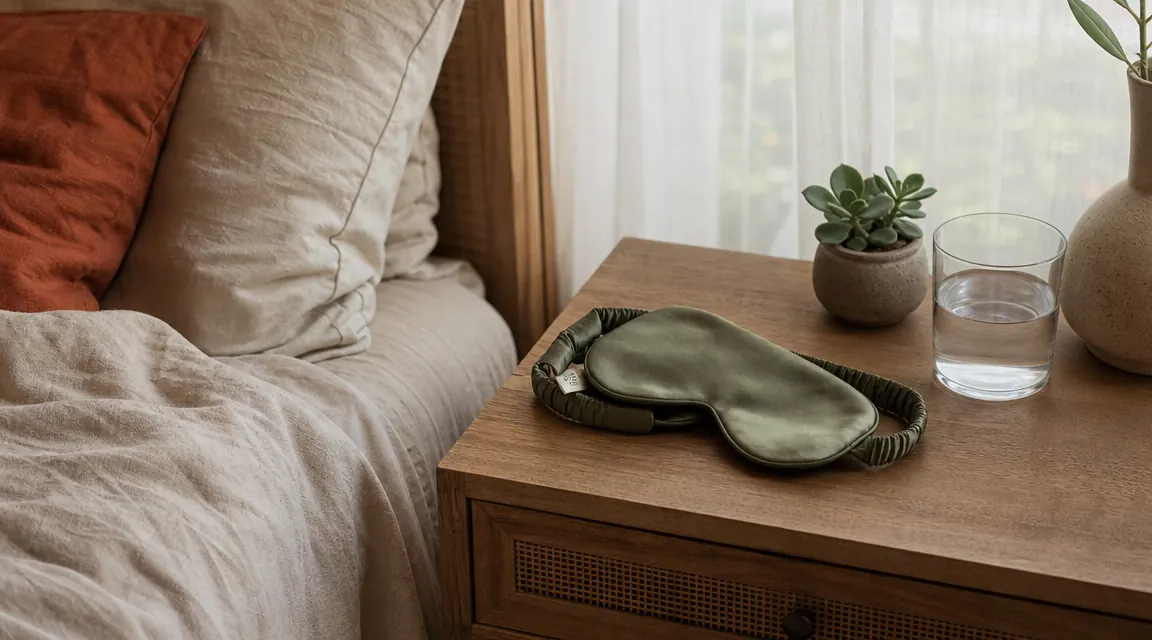
A note from Sungie: this is the story of how a simple Mulberry Silk Sleep Mask became the one piece of wind-down gear I will not travel without.
For two years I kept a running list on my phone called "sleep things that did not work." Melatonin at low doses, then medium doses, then not at all because it left me foggy until 10am. Magnesium glycinate, which helped with my legs but did nothing for the three-am staring-at-the-ceiling problem. A weighted blanket I loved so much I could not return it, even after I admitted it was making me too hot to fall asleep in summer. A sound machine that I genuinely liked but that my husband called "the ocean restaurant." A blue-light blocking app that made my phone look like a campfire and did not stop me from scrolling.
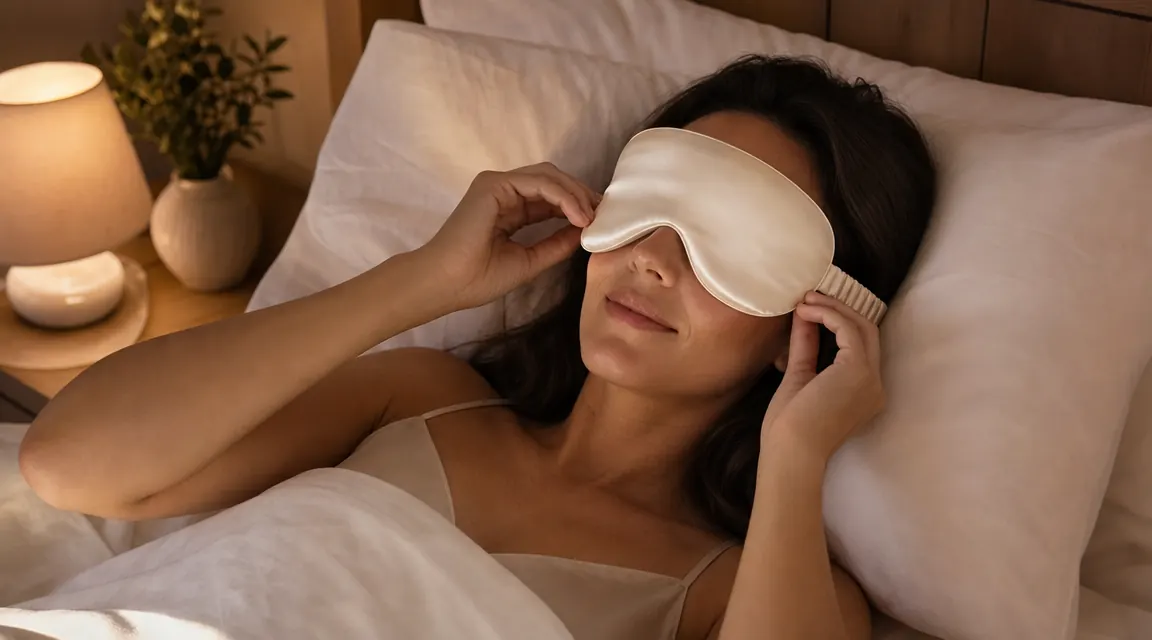
I was not sleeping badly by any clinical definition. I was sleeping the way I think a lot of women in their mid-thirties who practice yoga and care about their health sleep: adequately. Good enough. Seven hours, sometimes six and a half, with a stretch in the middle where I was aware of being awake and tried to breathe myself back down. Not a crisis. Just the low hum of not-quite-right that becomes normal before you realize it was never supposed to be normal.
My teacher used to say that savasana is the hardest pose, not because the body resists, but because the mind does not know what to do with actual stillness. I thought about that a lot during my ceiling-staring windows. The problem was not that I could not fall asleep. It was that even in the dark of my room, there was always some ambient light my brain decided to process. The neighbor's porch sensor, which trips for raccoons and deer in equal proportion. The pale glow of the smoke detector. The streetlight that gets through our linen curtains in exactly the stripe that lands across my eyes at two in the morning.
The problem was not that I could not fall asleep. It was that even in the dark, there was always some ambient light my brain decided to process.
A friend mentioned the silk sleep mask at a sound bath event, which is the most predictable place for that kind of conversation to happen, and I almost did not buy it because I had bought enough wellness things. But she said something specific that stayed with me: she said the silk version, the one with actual mulberry silk filling and shell, did not press on her eyelids the way foam masks do. That the interior dome cup gives the eyes room. I have very vivid dream recall and I have always had the vague sense that anything pressing on my closed eyes interferes with that. I cannot say if that is science or feeling, but I listened.
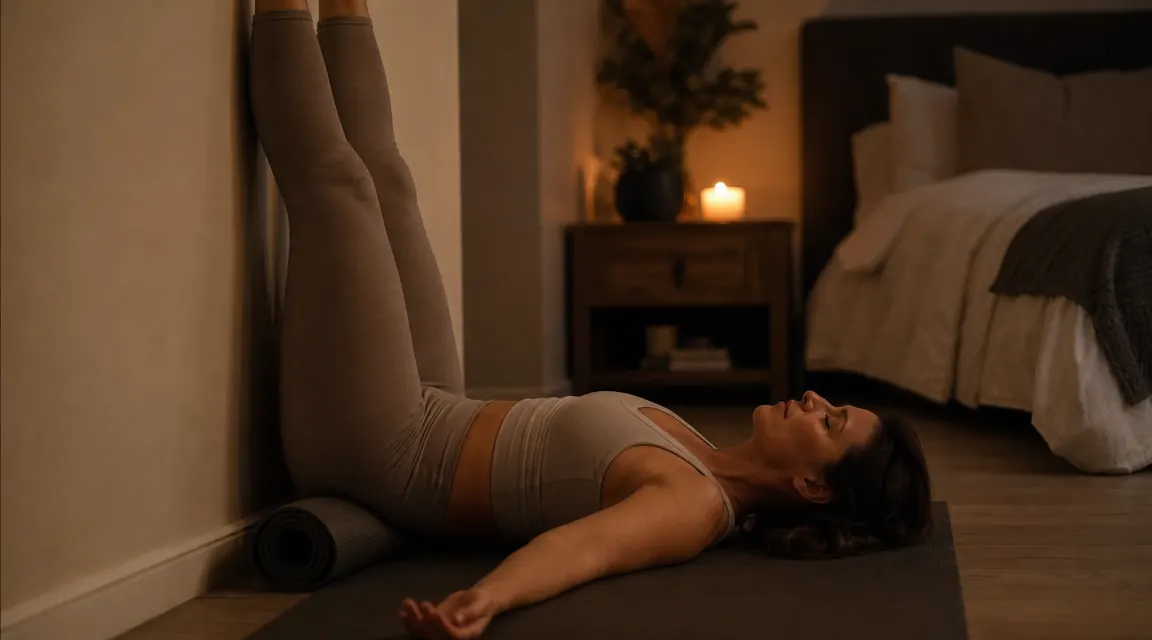
I ordered the 22 momme mulberry silk sleep mask that night. The ASIN my friend sent me was B0D5Y92N7C, rated 4.5 stars across more than five thousand reviews, which in the wellness category is meaningful because that many reviewers converging on that rating usually means the product does one thing very reliably. It arrived in two days and I wore it the first night before I had any expectation of it working.
Still waking up in the middle of the night for no reason you can name?
The 22 momme mulberry silk sleep mask is the one change I have kept without effort. Rated 4.5 stars by more than 5,000 reviewers. The adjustable strap fits without pulling, and the silk cup does not press on your eyelids.
Amazon Check Today's Price on Amazon →I woke up the next morning and did not check my phone to see what time I had been awake. I checked and the answer was: I had not been. Eight hours, continuous, in a room I had slept in for four years with the same light situation and the same husband and the same smoke detector. The only variable was a small piece of silk over my eyes.
Here is what I noticed in the weeks after. The adjustable strap is elastic enough to hold without tightening against my head, but I have not woken once from it shifting out of place, which was my experience with two cheaper foam masks I tried years ago. The silk shell is cool to the touch, which matters because I run warm, and it has stayed smooth after hand-washing, which I do about once a week. The molded cup inside the silk keeps pressure off my actual eyelids, and I do not know if this is why my dream recall has gotten sharper, but I notice that it has.
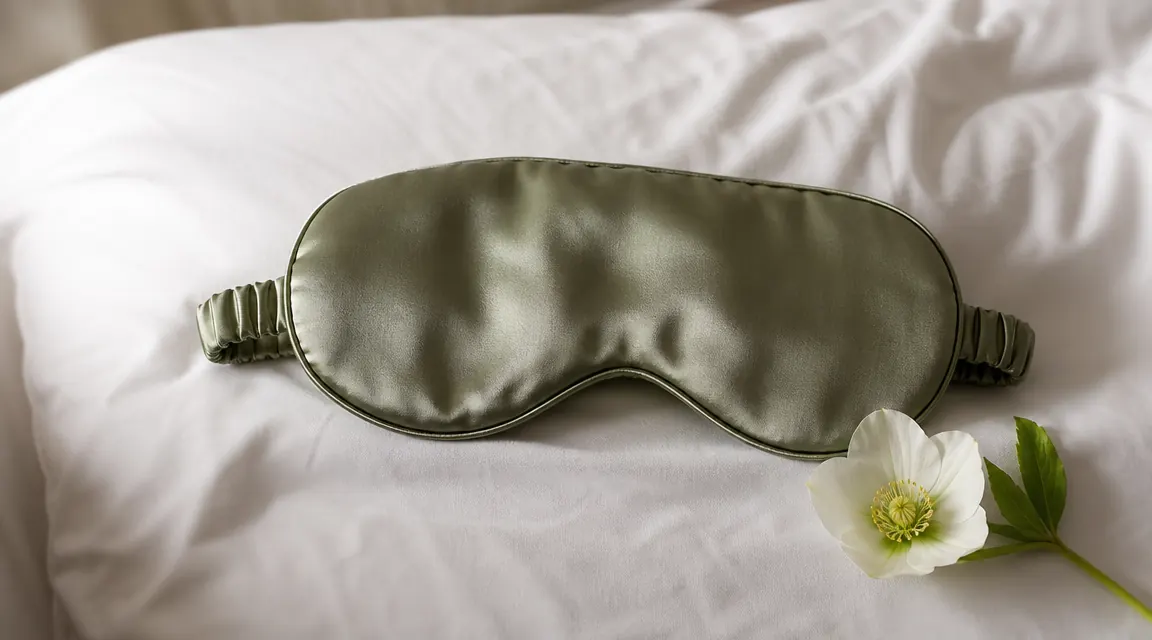
I also notice the ritual of it. I do my wind-down: the legs-up-the-wall for ten minutes, then the two minutes of slow breathing I borrowed from box breathing practice, then a few pages of whatever I am reading. When I reach for the mask, something settles. Not dramatically. Just the way the body recognizes a cue that has been repeated enough to carry meaning. In Ayurvedic terms I would call this a sankalpa, a small intention repeated until it becomes part of the nervous system's language. The mask is not magic. But it has become the signal my body reads as: we are actually going to rest now.
What I Would Tell You If We Were Sitting at My Kitchen Table
I would not oversell this. If you have real insomnia, a clinical problem, go see a doctor and look into CBT-I before you buy anything. If your room is already very dark, this may not be the dramatic shift it was for me. And if you run cold and prefer something with more warmth against the eyes, you may want to look at a different style, though I have not tried one I prefer to this.
But if what you have is the low hum of not-quite-right sleep, and you have already done the big things (no caffeine after two, consistent bedtime, cooler room), then I think the ambient light problem is worth taking seriously. We underestimate it because we adapt to it. The body finds a way to sleep despite the light, but the brain keeps a thin thread of alertness to process it, and that thread is often what makes the difference between sleep that restores and sleep that just passes time.
The silk makes it feel like something you chose deliberately, rather than a foam thing you are tolerating. That matters for consistency. I have worn it every night for six months now, and I cannot remember the last time I missed it. When I travel I pack it before I pack my toothbrush. That, more than any morning-after measurement, is how I know it worked.
Six months in, and I still reach for it before I reach for my book.
The 22 momme mulberry silk sleep mask. Smooth, cool, dome-cupped so nothing presses on your lids. 5,586 reviews, rated 4.5 stars. If you are going to try one change to your sleep setup, this is the one I would start with.
Amazon Check Today's Price on Amazon →