There is a paradox inside every evening yoga class. You come to settle, to exhale the day, to arrive somewhere quieter. But somewhere between standing splits and that last vinyasa, your heart rate climbed, your body temperature rose, and your sympathetic nervous system switched on. By the time you roll up your mat and drive home, you are more alert than you were an hour ago. And then you wonder why you cannot fall asleep.
This is not a problem with yoga. Evening practice genuinely supports deep sleep, but only when you treat what comes after the mat as part of the practice itself. The window between the final om and the moment your head hits the pillow is where most people leave rest quality on the table. I have been practicing yoga for eleven years, and the shift that most changed my sleep had nothing to do with which poses I chose. It had everything to do with what I did in the forty-five minutes after class.
If you are only going to add one physical tool to your wind-down, make it this.
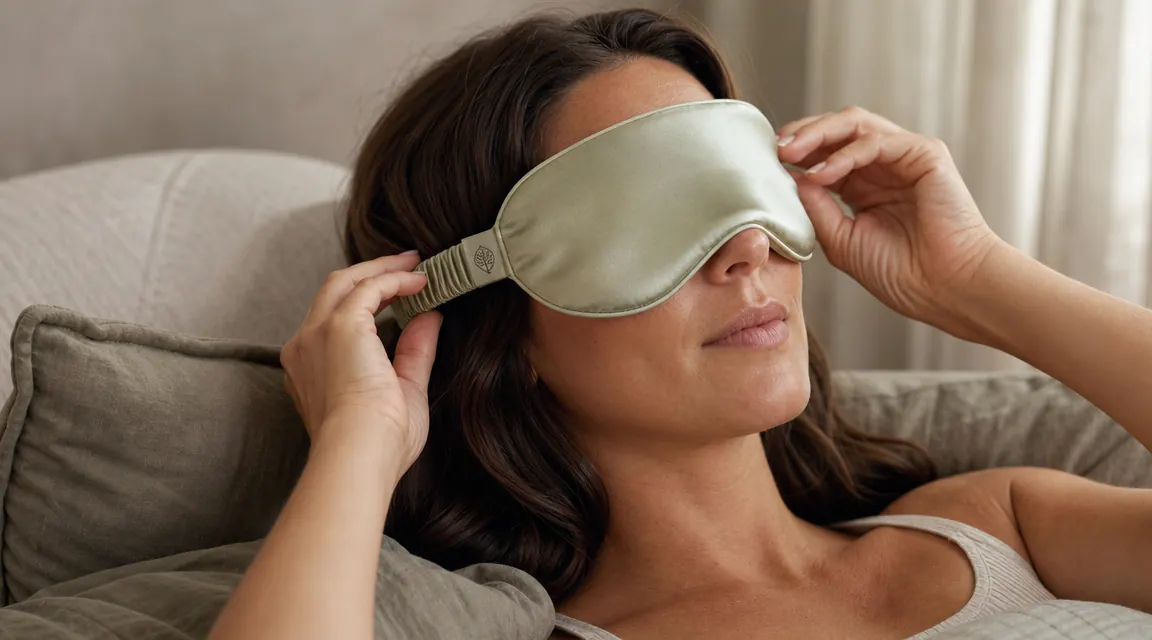
A 22 momme mulberry silk sleep mask signals total darkness to your brain the moment your head touches the pillow. It is lightweight, adjustable, and genuinely different from foam. More than 5,500 people use this one nightly.
Amazon Check Today's Price on Amazon →Step 1: Give Your Body 10 Minutes to Cool Down Before You Do Anything Else
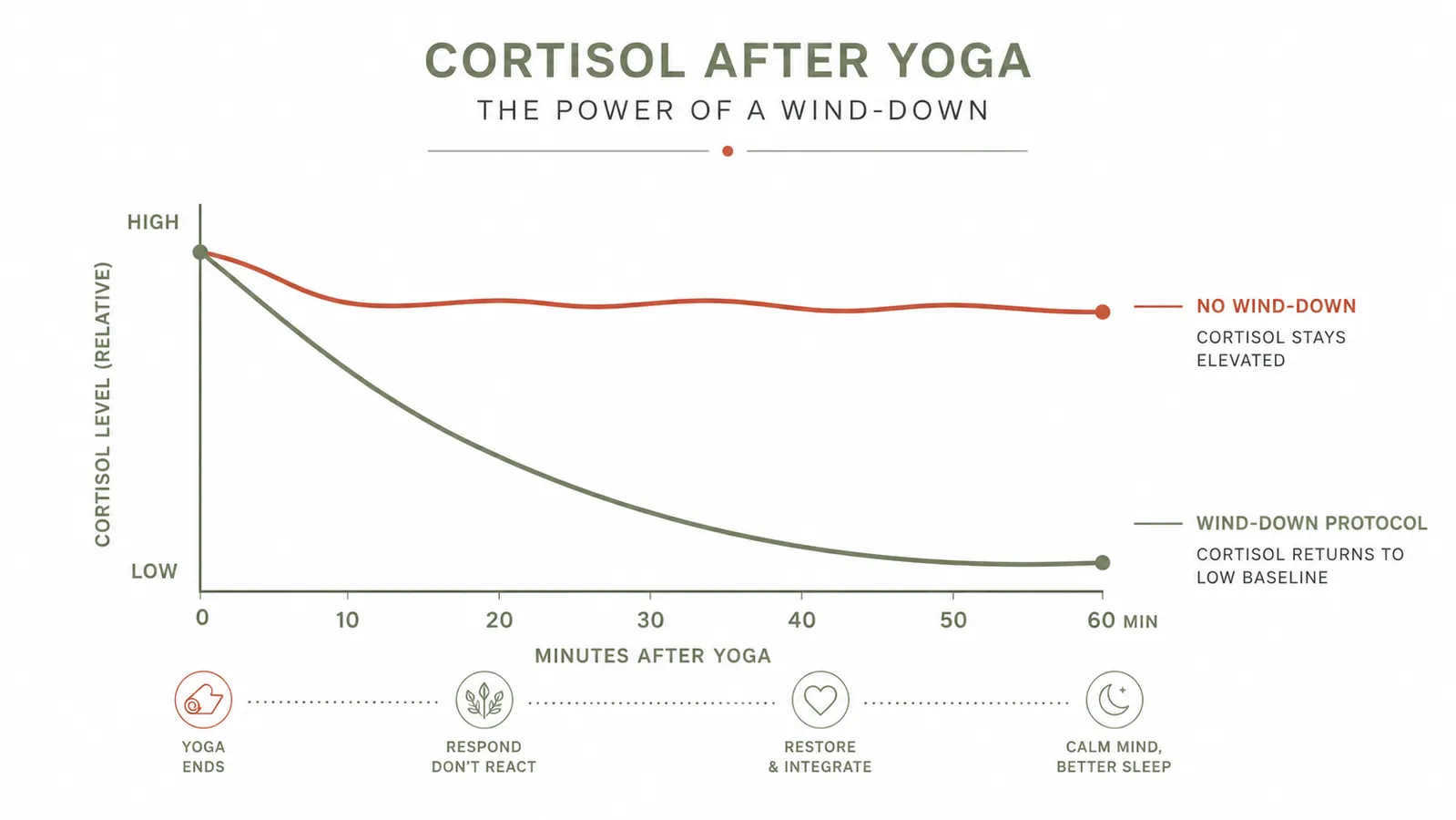
Core body temperature needs to drop before your brain can initiate sleep. After movement, your internal temperature is elevated, and your body's natural sleep-onset mechanism relies on that drop happening. If you rush from savasana to your car to your bedroom, you skip the cooling phase, and your body stays too warm to slide into the deep stages of sleep easily.
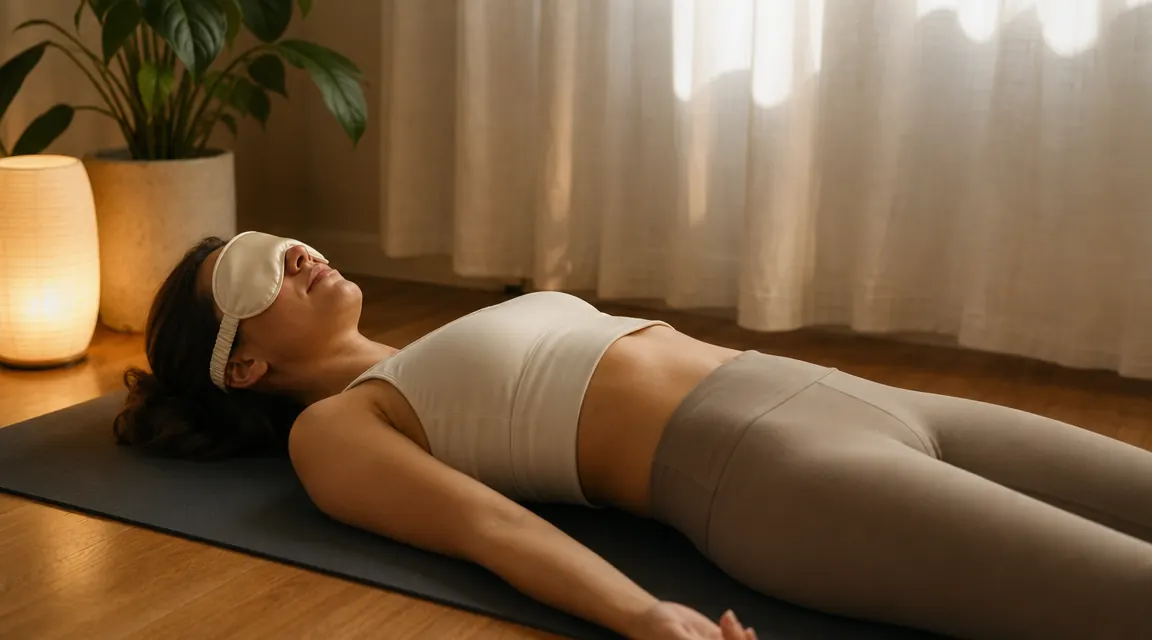
The simplest fix is intentional stillness. After your final pose, spend ten minutes lying in a truly supported savasana rather than a perfunctory one. Arms slightly away from your sides so the armpits are open. A blanket over you if the room is cool. Eyes closed. Let the room temperature draw the heat out of your skin. If you practice at a studio, this means actually staying for the full savasana rather than sneaking out when the teacher dims the lights.
When you get home, skip the hot shower. A lukewarm shower in the fifteen minutes after practice accelerates the cooling further by drawing warmth to the skin surface. This is not about discomfort, it is about working with the biology that is already trying to move you toward rest.
Step 2: Create a 20-Minute Screen Blackout After Your Mat Goes Away
The modern equivalent of lying awake counting sheep is scrolling a phone at full brightness while your brain is still in the mildly elevated state that follows physical exertion. Blue-spectrum light from screens suppresses melatonin, and the content on most social feeds is designed to hold your attention in a way that is directly opposed to sleep onset. After practice, your nervous system is already in transition. Every screen minute you spend is a minute of transition you forfeit.
Twenty minutes is the minimum threshold that most sleep researchers point to for meaningful melatonin recovery. In practice, I find that thirty is better, but twenty is enough to feel the difference the following morning. Use this window intentionally. Lay out your mat bag for tomorrow. Make a short grocery list on paper. Drink water slowly. Fold laundry. These are not exciting activities, and that is the point: boredom is a mild sleep aid.
Step 3: Use Three Minutes of Legs-Up-the-Wall to Shift Your Nervous System
Viparita Karani, legs up the wall, is one of the most underused poses in the context of sleep. It activates the parasympathetic nervous system through venous return, the passive draining of blood back toward the heart from the lower extremities. After a flow practice or vinyasa class, your legs have been working hard. Inverting them against a wall for even three minutes produces a measurable shift in heart rate variability, a reliable proxy for parasympathetic tone.
You do not need a yoga setup for this. A wall, a carpeted floor, and a folded blanket under your hips is enough. Set a quiet timer so you do not have to watch the clock. Close your eyes. Let your breath find its natural rhythm without directing it. The goal is not a breathing exercise, it is permission to stop. If you find thoughts arriving in a rush, that is normal: the body releases held material when it shifts positions. Let the thoughts move through without engaging them.
Three minutes is the floor. Five to ten is better. I have found that seven minutes in this position produces a quality of body-heaviness that makes the walk to the bedroom feel like the most natural next step in the world.
Step 4: Dim Every Light Source in Your Home to Near-Darkness
Your visual cortex is extraordinarily sensitive in the hour before sleep. The retinal ganglion cells that regulate circadian rhythm respond to ambient light levels in a way that your conscious attention does not track. You can feel tired and still have fully suppressed melatonin if the overhead lights in your home are at normal evening brightness. This matters twice as much after evening yoga because your body temperature is still returning to baseline, and every cue matters more during that window.
The practical target is lux levels below fifty in whatever room you occupy in the hour before bed. Overhead fixtures are almost always too bright. A single floor lamp with a warm-toned bulb, pointed at the wall rather than the ceiling, or a salt lamp, or a few candles, brings you into the right range. If you live with other people who want bright lights in shared spaces, a pair of amber-tinted glasses worn for the last hour is an effective workaround.
The wind-down is not a separate thing you add to your practice. It is the last fifteen minutes of your practice, and it is the part that determines whether everything before it lands.
Step 5: Block All Remaining Light the Moment Your Head Hits the Pillow
Even small amounts of ambient light, a streetlamp edge around the curtain, a charging indicator on a device, a smoke detector LED across the room, can interfere with sleep architecture at the cellular level. Your skin actually contains photoreceptors, and your eyelids are not opaque. This is not anxiety-inducing information; it is useful, because the fix is simple and inexpensive.
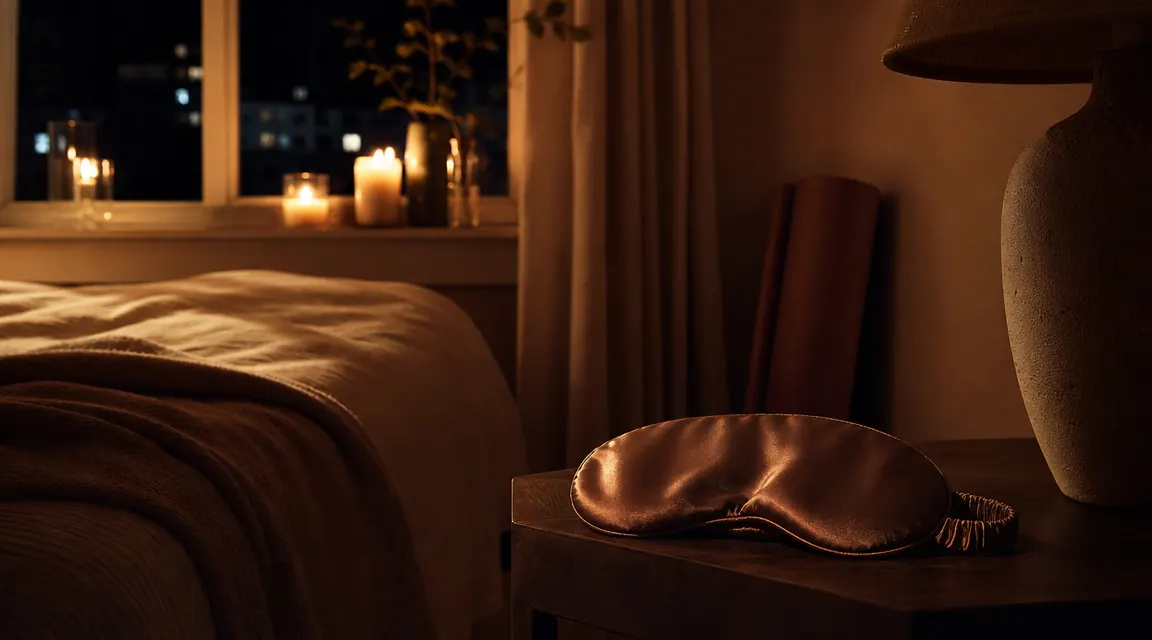
A well-fitted sleep mask creates total darkness without any room darkening work. The challenge with most foam masks is pressure on the eyelids, which causes its own kind of low-level alert state. Mulberry silk, specifically the 22 momme weight, sits against the skin with almost no pressure, holds its shape without a bulky cup structure, and stays cool through the night rather than trapping heat. I have used the 22 momme mulberry silk sleep mask for six months, and the difference from the foam mask I used before was apparent within the first two nights. The silk does not tug on the fine skin around the eyes, and the adjustable strap means it stays in place through any sleep position without creating pressure behind the ears.
This is the final step in the protocol because it is the one that seals the rest. You have cooled the body, removed screens, shifted the nervous system, dimmed your environment. The sleep mask is the period at the end of the sentence. It signals to your brain that the visual world is completely closed for the night.
What Else Helps
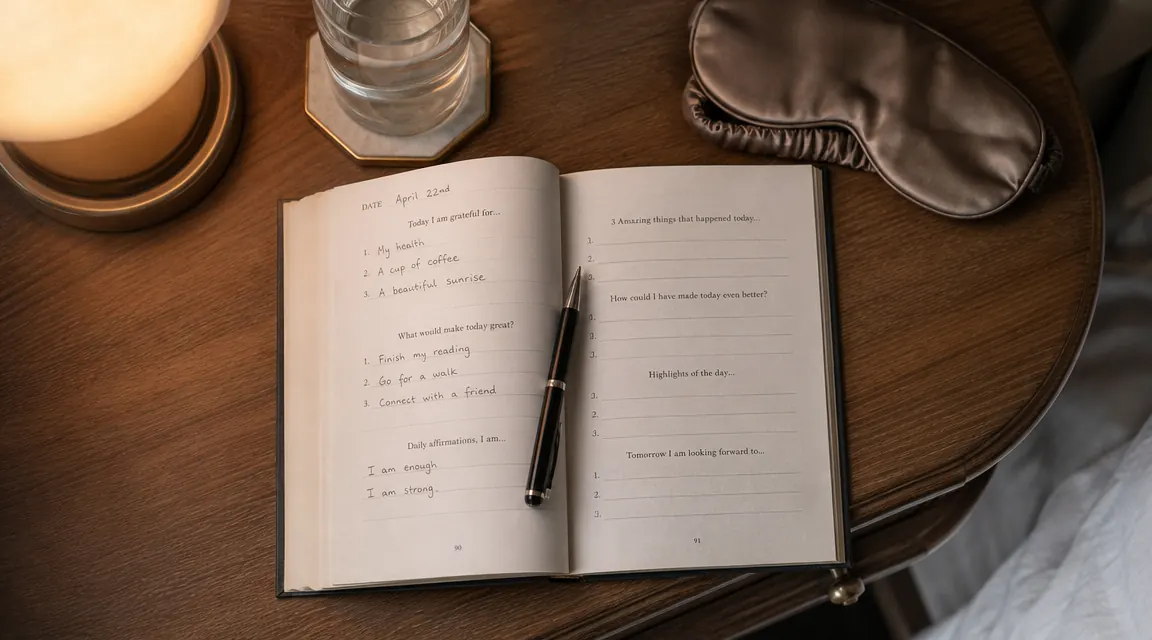
The five steps above form the structural protocol. A few supporting practices make the whole thing more durable over time. Magnesium glycinate taken thirty minutes before bed assists with muscle relaxation after a physical practice and supports the adenosine pathways that drive sleep pressure. A single page of journaling, noting three things from the day and one intention for tomorrow, takes less than five minutes and significantly reduces the intrusive thought patterns that can follow an active evening. Lavender essential oil diffused at low intensity in the bedroom has a modest but real effect on sleep latency in several small trials, and the ritual of turning it on becomes a conditioned cue over time.
What does not help, despite being commonly recommended: melatonin supplements taken in large doses. Most people take four to ten milligrams. Research suggests that 0.3 to 0.5 milligrams is the effective dose for sleep onset, with higher doses causing grogginess the following morning rather than deeper rest. If you use melatonin, consider cutting the standard tablet into a smaller portion. The effects are more refined at a lower dose for most people.
The deepest shift, though, is a conceptual one. Your evening yoga practice and your sleep are not separate events joined by a busy transition. They are one continuous arc of recovery, and the last act of that arc is the one that determines how well the whole thing lands. The mat teaches you to be present. The wind-down teaches you to carry that presence all the way to rest.
If you want to read more about the silk sleep mask specifically, including a full breakdown of momme weight, side-sleeper fit, and how it compares to cheaper alternatives, the long-term review covers six months of nightly use. And if you are curious about everything a silk mask does beyond blocking light, the 10 reasons piece goes deeper into the skin, circadian, and mood benefits.
Your practice deserves a finish line, not a trailing-off.
The 22 momme mulberry silk sleep mask is the simplest way to give your body permission to fully close the day. Adjustable strap, blackout fit, no pressure on the eyelids. Rated 4.5 stars by more than 5,500 people.
Amazon Check Today's Price on Amazon →