
It started as a small act of stubbornness. After three years of inconsistent sleep and increasingly scattered evening transitions, I decided I was going to build a real wind-down ritual. Not an elaborate one. Just something that told my nervous system the day was done. I added the ASAKUKI 500ml diffuser to a cart of other low-stakes wellness experiments and clicked purchase without much ceremony. That was a little over a year ago. The diffuser has run every evening since, mostly on the one-hour setting with lavender and cedarwood, and I want to give it a proper accounting now that I actually know what it does and does not do.
The ASAKUKI 500ml Essential Oil Diffuser has a 4.4-star rating across more than 70,000 Amazon reviews. That number is almost too large to be useful. It tells you the product is not a disaster, but it does not tell you what breaks first, which features you will actually use, or whether the thing is still running reliably a year in. That is what I want to cover here.
The Quick Verdict
Reliable, quiet, and genuinely long-lasting for a diffuser at this price. The LED lights are better than expected, the mist output is steady, and the auto-shutoff works without fail. The plastic housing feels like what it is, and the water level indicator could be clearer. A solid workhorse for anyone building a consistent aromatherapy practice.
Amazon Check Today's Price →If a consistent wind-down ritual has been elusive, a quiet reliable diffuser is a lower-stakes place to start than most people expect.
The ASAKUKI 500ml is currently one of the most reviewed diffusers on Amazon, and after a year of nightly use, I understand why it keeps selling.
Amazon Check Today's Price on Amazon →How I Have Used It
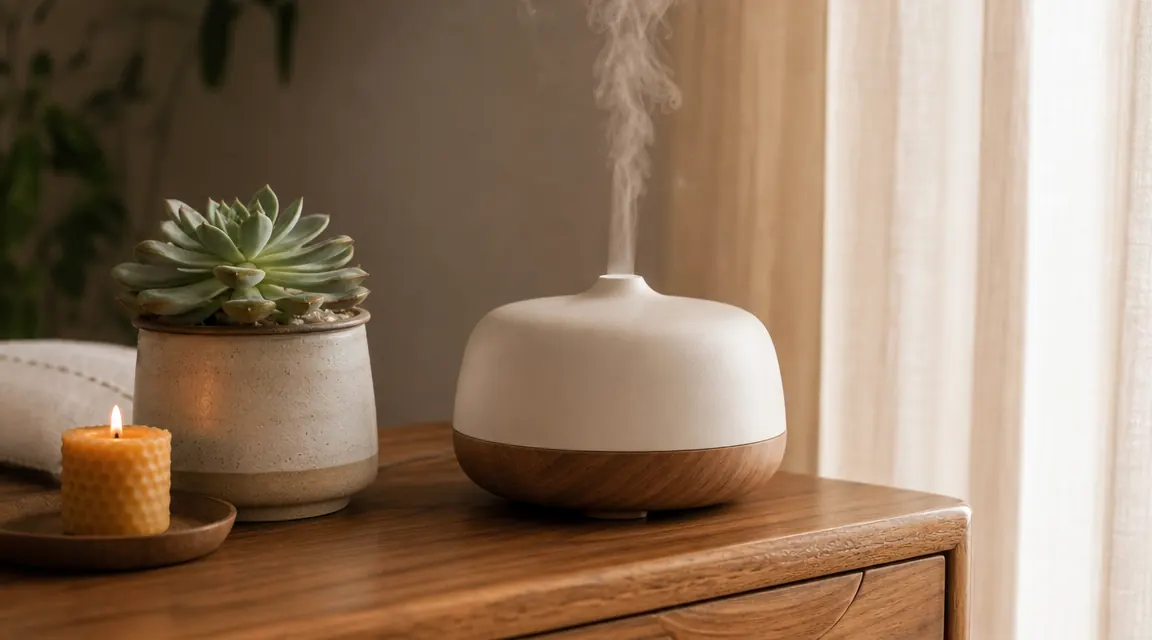
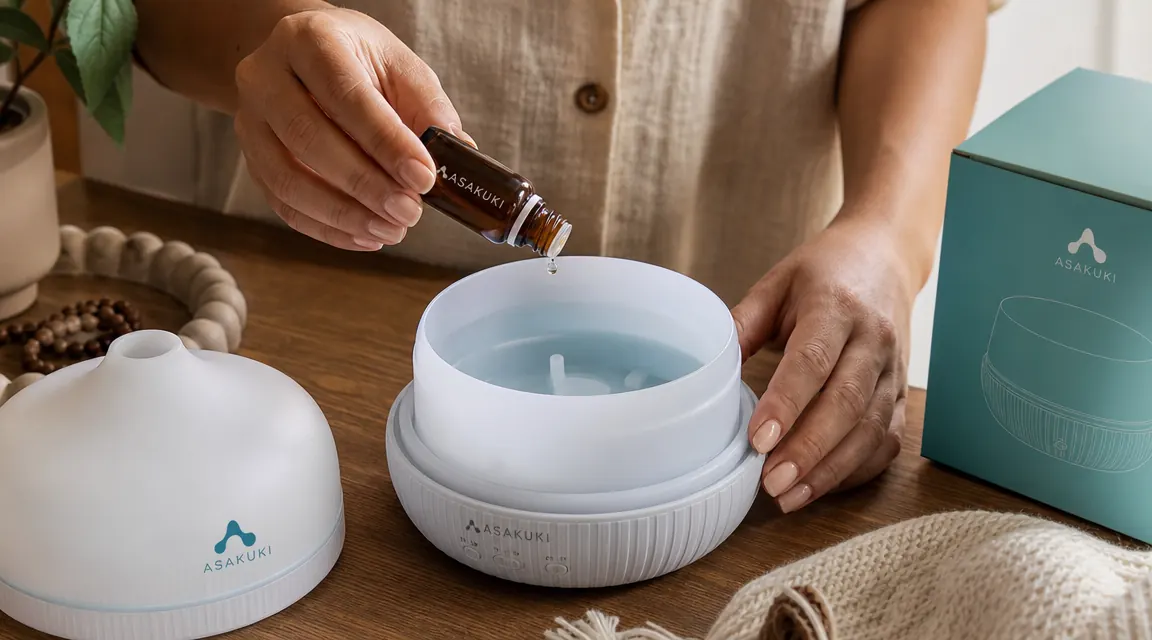
My setup is simple. The diffuser sits on the small wooden nightstand to the left of my bed. Every evening around eight, usually right after my floor practice or a short yin sequence, I fill it to just below the 500ml line with cool tap water, add four drops of lavender and two drops of cedarwood, and set it to the one-hour mist mode. I leave the LED on a dim amber and let it run until the auto-shutoff kicks in. In the morning it is always off, the reservoir is always dry, and the mechanism has never failed to stop on its own. That is twelve months of uninterrupted operation.
I have also used it on the continuous setting when I want a longer evening session, and occasionally in the living room during restorative practices. It is light enough to carry between rooms without thinking about it. I have tried about a dozen different oil combinations over the year, everything from peppermint and eucalyptus in the morning to bergamot and frankincense during journaling. The diffuser does not retain or transfer scents between uses, which I was worried about initially. A quick rinse between oils is enough.
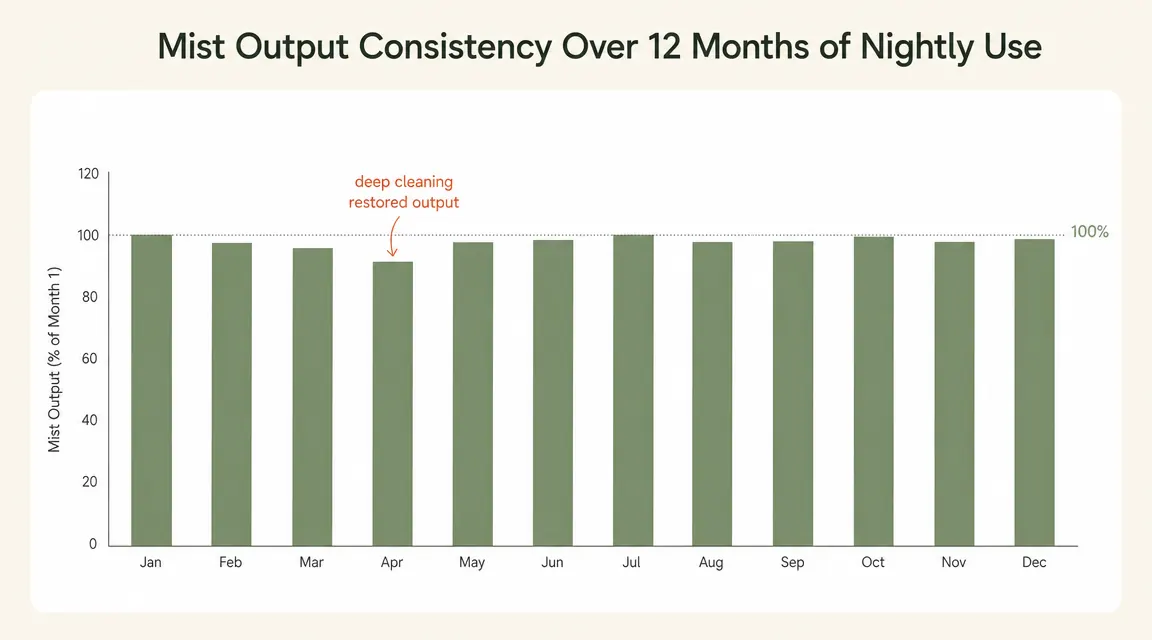
I do a deeper cleaning once a month with a few drops of white vinegar, a gentle wipe of the interior, and a rinse. At month four, mist output had visibly dropped. That monthly deep clean brought it back to full strength within two uses. I have not had a drop in output since, which suggests the issue was mineral buildup rather than mechanical degradation. If you live in a hard-water area, the monthly clean is not optional.
Mist Output and Coverage: The Practical Numbers
The 500ml tank is larger than most entry-level diffusers, which typically run 100ml to 300ml. At the intermittent mist setting, I get roughly four to five hours of run time from a full tank. On continuous, it runs about two to three hours. For a bedroom that is roughly 180 square feet, the scent fills the room within about fifteen minutes and stays present without being overwhelming. I have read reviews complaining the scent is too faint, but in my experience that is an oil-to-water ratio issue, not a hardware limitation. Starting with three to four drops and adjusting from there gives you real control.
The mist itself is cool and ultrasonic, not heat-based. This matters for oil quality. Heat diffusers break down the chemical compounds in essential oils that give them their therapeutic properties. Cool mist preserves them. For anyone who invests in quality oils, this is not a minor distinction.
The mist does not waver. It does not rattle. It does not require my attention. After a year it has become as invisible as a good habit should be.
The LED Lighting: More Useful Than I Expected
I assumed I would ignore the color-changing LED entirely. I was wrong. The ASAKUKI has seven color options and a remote control that lets you cycle through them or lock onto a specific one from across the room. I keep mine on a fixed warm amber, which is the closest to firelight and the least disruptive to melatonin production. That one feature, the ability to set a fixed dim warm color, genuinely earns its place in the product. I use it instead of my bedside lamp during evening reading sometimes.
The remote itself is small and somewhat cheap-feeling, but it works reliably. Replacing the battery once over the year is the only maintenance it has required. If you prefer not to use the remote, the on-unit controls handle everything the remote does, just with a bit more button cycling. The remote is the easier path.
What Has Actually Held Up After 12 Months
The ultrasonic plate still vibrates cleanly. The auto-shutoff fires every time. The LED functions across all seven colors. The mist output, after the month-four cleaning adjustment, has stayed consistent. The exterior has a few faint watermarks where condensation pooled during a particularly humid summer, but nothing structural. The power cord is intact. The sealing ring around the lid shows no cracking or warping.
I will also note what I was uncertain about going in: whether ultrasonic diffusers have a defined lifespan before the internal vibrating disk degrades. The answer, based on my experience and some research, is that the disk can last three to five years with proper cleaning. One year in, I see no indication of degradation. The mist volume looks the same as it did in month one.
The one genuine mechanical concern: the water level lines inside the reservoir are embossed rather than printed, which makes them difficult to read in dim light. I have slightly overfilled the tank twice in a year, which causes the auto-shutoff to trigger early. A printed line or a contrasting color would fix this completely. It is a small design oversight in an otherwise well-considered product.
What I Liked
- Reliable auto-shutoff with no failures in 12 months of nightly use
- Cool mist ultrasonic mechanism preserves oil compounds intact
- 500ml tank offers four to five hours of intermittent mist without refilling
- Remote control allows adjusting mist and LED from bed without getting up
- Seven LED color options with a fixed warm amber setting that is genuinely useful for sleep
- Quiet enough that I have forgotten it was running while meditating nearby
- Easy to clean, and monthly deep cleaning restores output reliably
Where It Falls Short
- Water level indicator is embossed, hard to read in dim light
- Plastic housing does not feel premium, especially compared to ceramic alternatives
- Remote control feels lightweight and cheap, though it functions reliably
- Requires monthly deep cleaning in hard-water areas or output drops noticeably
- No timer option beyond the fixed one-hour and three-hour settings and continuous
How the ASAKUKI Compares to What I Used Before
Before the ASAKUKI I used a 100ml diffuser I picked up at a craft store. It ran dry every forty-five minutes, which meant I either had to get up and refill it mid-practice or accept that it would shut off before I fell asleep. That constant interruption meant I rarely used it past the first month. The 500ml tank solved this completely. One fill at the start of the evening is enough.
The higher-end alternative most people consider alongside the ASAKUKI is the Vitruvi Stone Diffuser, which runs substantially more. The Vitruvi is genuinely beautiful, a glazed ceramic object that looks intentional on a shelf. If your space matters to you aesthetically and budget is not the primary filter, the Vitruvi is worth looking at. I cover that comparison in more depth in my piece on the ASAKUKI vs Vitruvi diffuser comparison. But if your question is whether the ASAKUKI performs its core function reliably for sustained daily use, the answer is yes.

The Aromatherapy Practice, Not Just the Hardware
A diffuser is not a wellness practice on its own. It is infrastructure. What makes it useful is the ritual it anchors. Over the past year, turning on the ASAKUKI has become a reliable sensory cue: lavender and cedarwood means we are done for the day. My nervous system has learned this. Sleep onset has improved, not dramatically, but measurably. The diffuser did not cause that. The consistency did.
If you are building or rebuilding an aromatherapy practice from scratch, the equipment decision is the easy part. The harder part is choosing two or three oil combinations that you actually enjoy and sticking with them long enough for your body to associate the scent with a particular state. The ASAKUKI is good enough hardware to stop being an obstacle in that process. That is the most useful thing I can say about it.
If you want a full framework for building a daily aromatherapy ritual that connects to your yoga and sleep routine, I wrote a separate guide on that: 10 ways an aromatherapy diffuser elevates your wellness ritual. It goes deeper on oil choices, timing, and how to layer diffuser use into morning and evening routines.
Who This Is For
The ASAKUKI 500ml is right for you if you want a reliable daily-use diffuser that will not require your attention once you set it up, if you prefer cool mist for oil integrity, and if you want LED versatility without paying a premium for ceramic aesthetics. It is also right for anyone who has tried smaller 100ml diffusers and found the constant refilling broke their evening rhythm. The 500ml tank makes a genuine practical difference.
Who Should Skip It
If the diffuser is going to sit prominently in a thoughtfully designed space, and you care about the object being as beautiful as the ritual, the plastic ASAKUKI will likely disappoint you. The Vitruvi or a similarly designed ceramic diffuser will satisfy that need in a way the ASAKUKI was not built to. Also, if you live in an extremely hard-water area and cannot commit to a monthly cleaning cycle, mineral buildup will become a real maintenance issue faster than it would in average conditions.
One year in, I would buy this again without hesitation. Not because it is extraordinary, but because it does exactly what a daily ritual tool should do: it disappears into the practice.
The ASAKUKI 500ml is consistently one of the most affordable high-capacity diffusers available. If you are ready to build a real aromatherapy habit, the hardware is a reasonable place to start.
Amazon Check Today's Price on Amazon →