
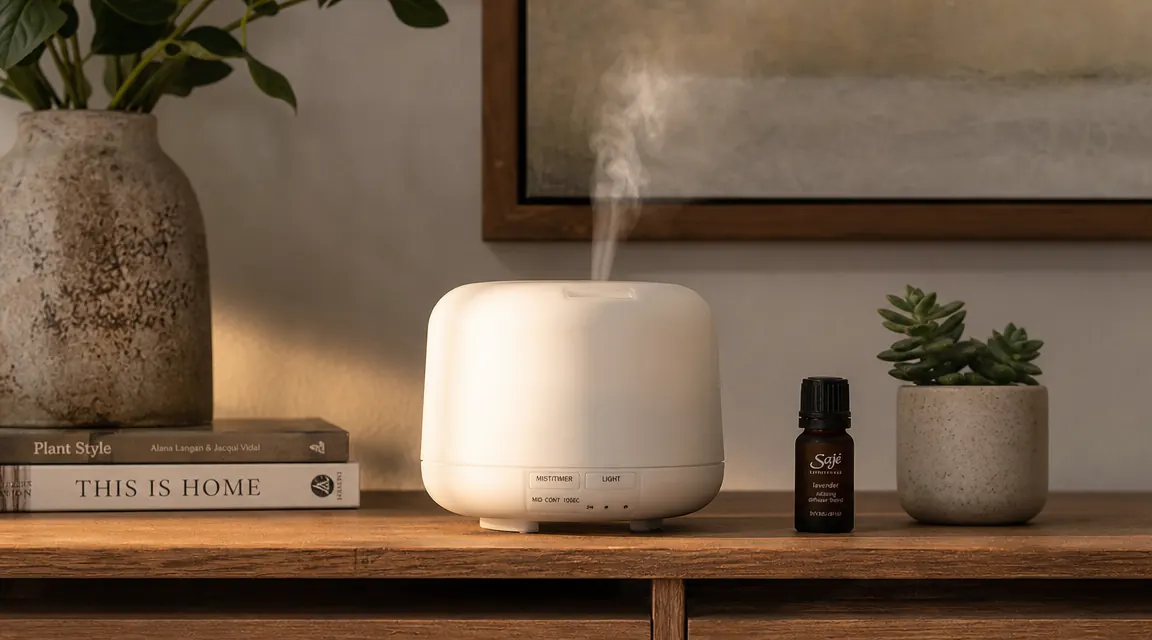
Here is the honest version of this comparison: both diffusers work. You put water and oil in, they mist it into the air, your room smells like whatever you chose. The question is not whether they work. The question is what you are actually paying for when you choose one over the other. Vitruvi's Stone diffuser costs around $119. The ASAKUKI 500ml sits at a fraction of that. With 70,000 Amazon reviews, the ASAKUKI is not a dark horse. But Vitruvi has cultivated a design-forward following that makes it feel like more than a diffuser. So let me walk you through what each one actually does, where each one earns its place, and who should buy which.
I have had the ASAKUKI running nightly for about fourteen months now, and I have spent time with the Vitruvi Stone in a studio setting. My practice has benefited from both. But my wallet and my humidity preferences point in one direction pretty clearly.
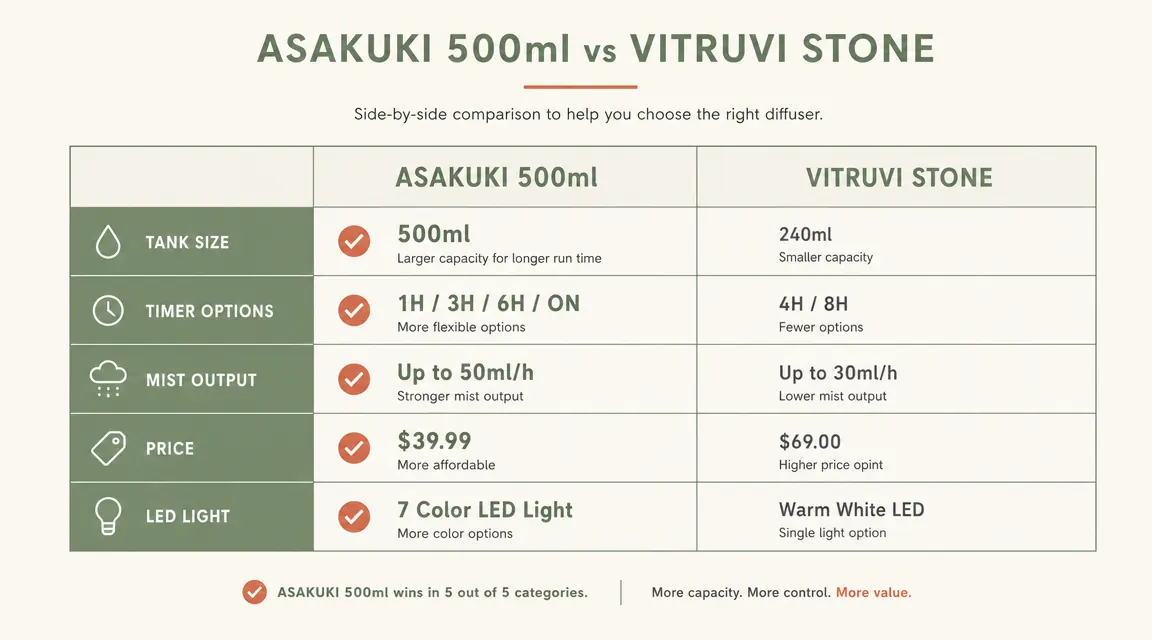
| feature | left | right | winner |
| feature | left | right | winner |
| feature | left | right | winner |
| feature | left | right | winner |
| feature | left | right | winner |
| feature | left | right | winner |
| feature | left | right | winner |
| feature | left | right | winner |
| feature | left | right | winner |
| feature | left | right | winner |
Where the ASAKUKI Wins
The 500ml tank is the clearest advantage. When I run lavender and cedarwood before an evening yin practice, I want the diffuser running from the moment I roll out my mat until well after I am in savasana and settled into sleep. The ASAKUKI does that without me ever having to refill. At 10 hours of continuous runtime, it covers an entire night. The Vitruvi, with its 90ml reservoir, runs for perhaps three to four hours before it shuts off. For a brief morning practice that is fine. For an evening ritual that flows from practice into sleep, you will wake up in a dry room and realize the scent stopped hours ago.
The four timer modes are genuinely useful, not just a spec-sheet item. I use the three-hour setting most nights. I start it when I begin my pranayama work and it shuts off quietly while I am already asleep. No need to remember it. The remote control is another detail I did not expect to value this much. Lying in legs-up-the-wall after a long practice and reaching over to tap a remote to cycle the LED from white to off is a small thing. But small frictions matter when the point of the practice is ease. The ASAKUKI removes that friction at a fraction of the cost of its competition.
Your evening ritual deserves a diffuser that runs all night without refilling.
The ASAKUKI 500ml has 70,000 reviews, a remote control, and four timer settings. It handles everything from a 90-minute practice to a full night of sleep aromatherapy without interruption.
Amazon Check Today's Price on Amazon →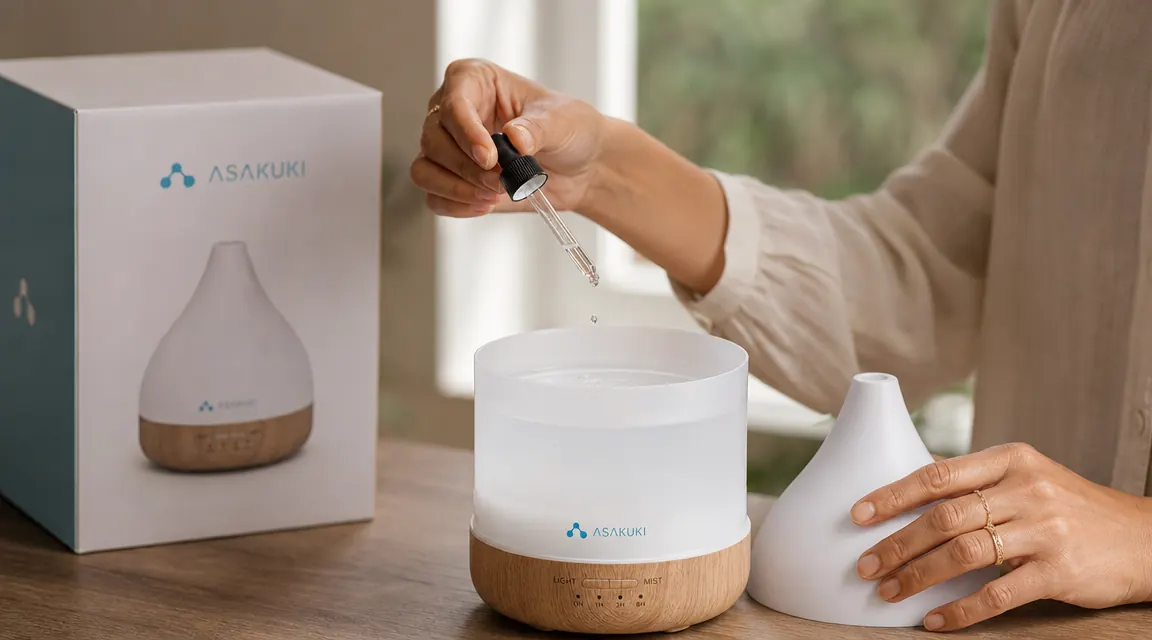
Where Vitruvi Wins
I want to be fair here, because Vitruvi has built something genuinely considered. The Stone diffuser is a design object in the honest sense. It is matte, minimal, and sits on a shelf the way a smooth river stone would. If you have an aesthetic practice space, if your studio corner has clean lines and intentional objects, the Vitruvi belongs there in a way the ASAKUKI simply does not. There is no shame in that. The material things we choose for our practice spaces affect how we feel in them. If the sight of a white plastic unit on your cedar shelf pulls you slightly out of the mood you are cultivating, that matters.
Vitruvi is also extremely quiet, a half-step quieter even than the already-quiet ASAKUKI. In a very still room during a long seated meditation, that difference is perceptible if you are listening for it. And some practitioners are. The Vitruvi uses a nebulizing method that some aromatherapy purists prefer, arguing it disperses oil molecules more completely without the dilution of a large water reservoir. That argument has some merit, though the practical scent difference in a normally-sized room is minimal.
Your practice space shapes your practice. The question is whether a design premium solves a real problem, or whether you are paying for a photograph on your shelf.
The Mist Output Difference (and Why It Matters for Wellness Rituals)
People sometimes conflate diffuser output with diffuser intensity. The ASAKUKI pushes significantly more mist volume than the Vitruvi. In a 12x14 bedroom, you will feel the ASAKUKI humidifying the air, which in dry winters is a real benefit, not just aromatherapy. Your sinuses will notice. Your skin will notice. If you practice in a dry climate or heat your home in winter, that incidental humidification is a meaningful side effect of choosing the larger-tank unit.
The Vitruvi's lower output is more appropriate for a small dedicated meditation corner or a bathroom shelf during a bath ritual. It scents the immediate area without saturating a larger room. If your practice happens in a compact, defined space rather than an open bedroom, the Vitruvi's lighter output is actually better suited. Scale your choice to your space.
What 70,000 Reviews Actually Tell You
A product accumulates 70,000 reviews in one of two ways: it is purchased by an enormous number of people who feel nothing strongly enough to write a review but it stays on the shelves, or it is genuinely satisfying in a way that prompts people to take a moment and say something. The ASAKUKI sits at 4.4 stars across that volume, which tells you something specific. It is not a 4.9-star outlier that ten thousand yoga practitioners love with devotion. It is a 4.4-star tool that a very wide range of people bought, tried, and found reliable enough to return to.
The negative reviews cluster around two things: occasional units arriving defective (which happens with any high-volume electronics), and the plastic construction feeling less premium than expected. Neither is a functional complaint. The diffuser works. The build is utilitarian. If that trade sits well with you, the ASAKUKI is a clear choice. If you find yourself drawn to objects that feel considered and weighty in the hand, the Vitruvi speaks to a different part of the same desire.
Who Should Buy Which
Buy the ASAKUKI if your practice flows from an active yoga session into an extended wind-down, if you use the diffuser throughout the night, or if you want timer control and remote flexibility without thinking about the diffuser again once it is running. Buy it if you are new to aromatherapy and want to experiment with oils across a long session before committing to what works for you. Buy it if the utilitarian look of a white unit does not pull you out of your space. At its price, you can also afford good oils with the difference you save.
Buy the Vitruvi Stone if you have a specific, contained practice corner where objects carry weight, if you practice brief focused morning sessions rather than long evening flows, and if you are already deeply committed to a few oils you love rather than experimenting widely. Buy it if the aesthetic of your space is something you have invested in and you want the diffuser to belong rather than merely function. It is a beautiful, limited tool for a specific practitioner.
One more thing worth saying plainly: the ASAKUKI lets you put the savings toward oils, a meditation cushion, or a better mat. The Vitruvi premium covers its design and its brand story. Neither of those facts is a moral judgment. They are just the honest math of what each dollar is doing.
For most yoga and wellness practitioners, the ASAKUKI 500ml is the clear, practical choice.
Fourteen months of nightly use has not changed my recommendation. Timer control, remote, 10-hour runtime, and a tank large enough to cover an entire evening practice and sleep. If you want more from your aromatherapy ritual and less from your diffuser's maintenance demands, this is the one.
Amazon Check Today's Price on Amazon →