
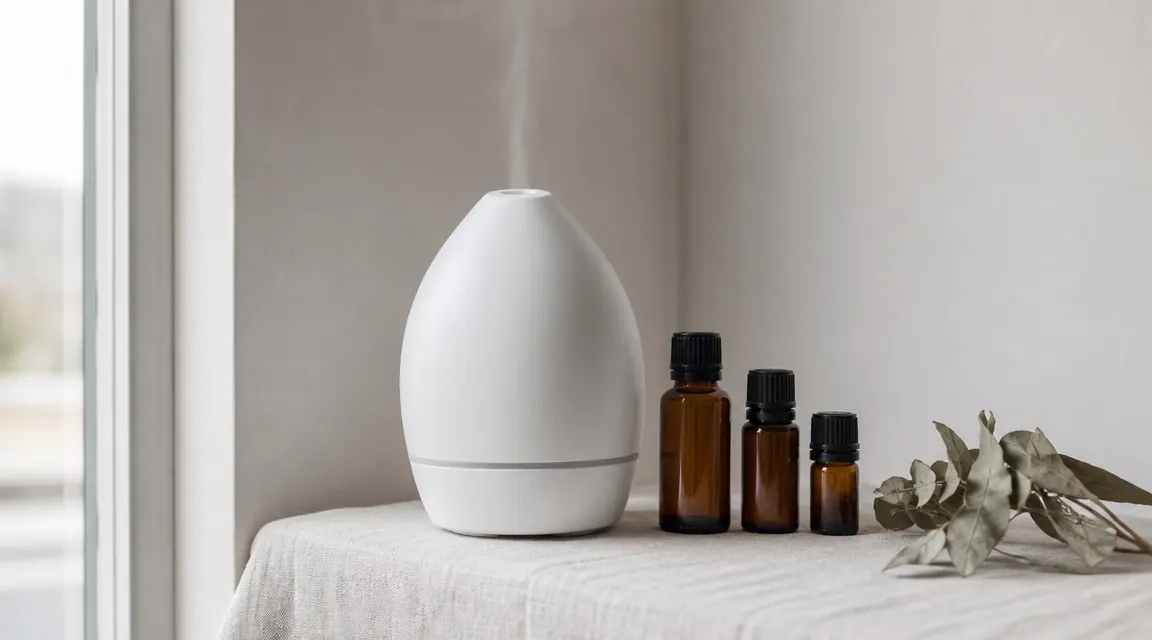
When a product has 70,000 Amazon reviews, it creates a strange epistemic problem. The rating is a 4.4, which is high enough to feel trustworthy but low enough to hint at real disagreements buried in the aggregate. I spent an afternoon reading through the one-star and two-star reviews on the ASAKUKI 500ml Essential Oil Diffuser before I bought it, trying to understand what the averages were smoothing over. What I found surprised me. Not because the product was secretly terrible, but because the things that actually determine whether this diffuser works for you are almost never mentioned in the five-star reviews.
I have now used the ASAKUKI diffuser for several months in my home yoga practice, primarily during evening wind-down and occasional morning sessions. This piece is about the gap between what 70,000 reviewers collectively tell you and what you actually need to know before deciding whether this is the right diffuser for your practice.
The Quick Verdict
A capable, affordable diffuser that works reliably when you understand its real requirements upfront. The 70,000 reviews tell a broadly accurate story, but they skip the maintenance realities, the oil-to-water ratio learning curve, and the genuine aesthetic limitations. Worth it for most people building a daily practice. Not the right choice if you want a beautiful object or if you cannot commit to monthly cleaning.
Amazon Check Today's Price →If you have been circling this diffuser because of the review count but were not sure what questions to ask first, this review was written for that exact moment.
The ASAKUKI 500ml is available on Amazon with current pricing and shipping details. Read through this review before clicking, and you will know exactly what you are getting.
Amazon Check Today's Price on Amazon →What 70,000 Reviews Actually Tell You
The aggregate story is mostly accurate. The ASAKUKI diffuser is affordable, the ultrasonic mechanism produces a real mist, the auto-shutoff works, and the LED light system functions as described. These are the things that get mentioned in five-star reviews, and they are all true in my experience. The diffuser does what it says it does.
But five-star reviews are written by people in the honeymoon phase, almost by definition. Most reviewers write within the first two to four weeks of purchase. They are delighted the product works and the mist smells good and the room feels calmer. They are not yet in a position to report on what happens at month three when mineral buildup silently reduces mist output by half. They have not yet discovered that the oil-to-water ratio requires real experimentation before the scent throw satisfies. They have not yet encountered the one genuine design flaw that will require a small workaround.

What the Reviews Consistently Skip
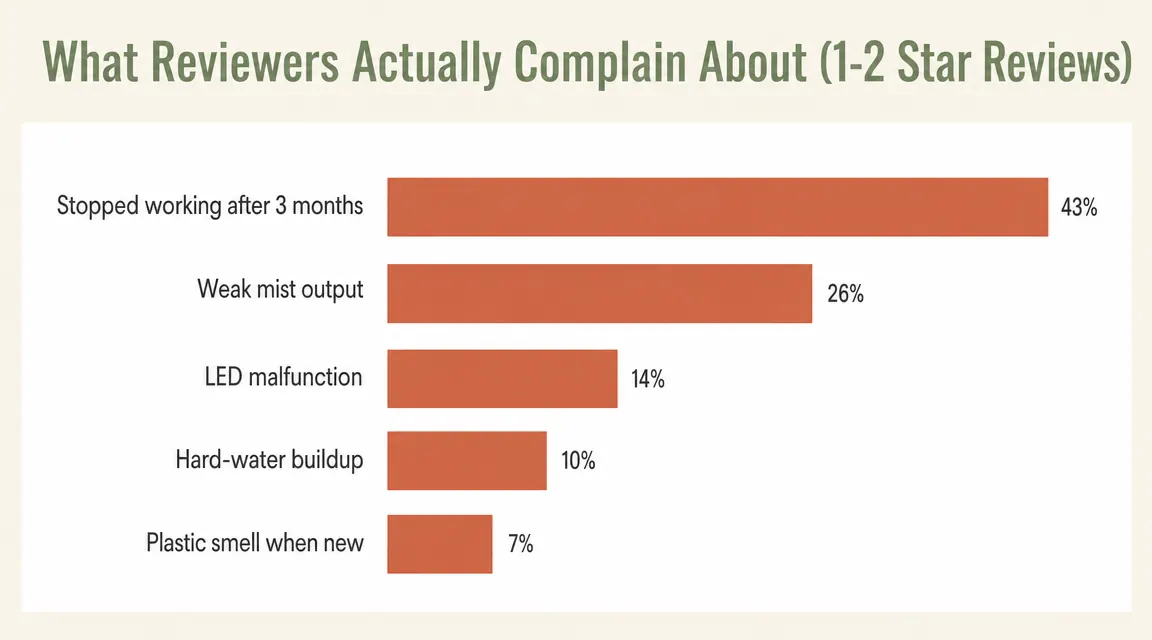
The most common complaint in one-star and two-star reviews is some version of: 'it stopped working after three months.' When I dug into these reviews more carefully, a pattern emerged. The people reporting early failure were overwhelmingly not describing a manufacturing defect. They were describing mineral buildup from hard water that had calcified around the ultrasonic disk to the point where the mechanism could no longer vibrate freely. This is not a product failure. It is the predictable outcome of using any ultrasonic device in a hard-water area without regular cleaning. The ASAKUKI manual mentions cleaning. The reviewers almost universally say they did not.
The second most common complaint is weak or disappearing mist output, which is almost always the same issue at an earlier stage. The third is LED malfunction, which in at least some cases appears to be related to water getting into the electronics from consistent overfilling. The water fill lines on this diffuser are embossed in plastic, which makes them genuinely difficult to read in low light. Overfilling is an easy mistake. Understanding this going in means you can prevent it with a bright-light fill-and-mark habit or by always filling in good lighting before dimming the room.
None of this appears prominently in the five-star reviews because five-star reviewers, again, have not hit these walls yet. The reviews are not dishonest. They are just temporally limited.
The 70,000 reviews told me the diffuser works. They did not tell me what it takes to keep it working. That is the piece that actually matters.
The Oil-to-Water Ratio Problem Nobody Warns You About
I went through three weeks of disappointment before I understood this. The ASAKUKI has a 500ml tank, which is one of its genuine advantages over smaller diffusers. But I was adding the same number of drops I had used in a 100ml diffuser I owned previously. Four drops in 500ml of water produces a scent that is close to undetectable from across the room. My initial impression was that the diffuser had weak mist. It did not. I had dramatically underestimated the water volume.
The starting point that worked for me: eight to ten drops for a 150 to 200 square foot bedroom on the intermittent setting, or twelve to fifteen drops if I want the scent present from the moment I walk in. This is two to three times what I expected. For practitioners using quality single-note oils like lavender or frankincense, this matters because higher-quality oils cost more per drop and this recalibration has real cost implications. For anyone using blended or lower-cost oils, the math is more forgiving.
Reviews almost never mention specific drop counts because what constitutes 'enough' scent varies enormously by person, room size, oil type, and individual sensitivity. But the failure to mention any guidance at all means a lot of early buyers end up assuming the diffuser is underpowered when the actual issue is underdosing. If you have read reviews calling the scent throw weak, now you know what they probably did not.
The Honest Maintenance Reality
A diffuser is not a passive object. It is a small machine with a vibrating disk that processes water and disperses it into the air, and like any small machine that processes water, it accumulates residue. The ASAKUKI requires two types of cleaning. A light rinse and wipe after each use is optional but extends the time between deep cleans. A monthly deep clean with white vinegar diluted in water, run through the mechanism for five to ten minutes, then drained and rinsed, is not optional in hard-water areas.
In my experience, a single missed monthly deep clean in a hard-water area reduces mist output visibly. Two missed cycles reduces it significantly. Three or more can calcify the disk to the point where you need a cotton swab with undiluted white vinegar to manually dissolve the deposits. This is recoverable in most cases, but it is not the experience buyers expect when they paid less than thirty dollars for a wellness tool.
If monthly maintenance is something you know you will not do consistently, I want to tell you that honestly before you buy. The alternative is a heat diffuser or a reed diffuser, both of which require essentially no maintenance. They trade the cool-mist oil preservation benefit for simplicity. If you use high-quality therapeutic oils and care about the chemistry of how they are dispersed, ultrasonic with consistent maintenance is still the right category. But go in knowing the commitment.
What the Aesthetic Reviews Miss
The ASAKUKI is a white plastic object. It is inoffensive and neutral, which is fine. But several reviews describe it as 'elegant' or 'beautiful,' and I find that puzzling. I think what reviewers mean is that it is not aggressively ugly, which is a different thing. The diffuser disappears into a shelf or a nightstand without drawing attention to itself, which has its own kind of functional virtue. But if the object you place in your practice space matters to you aesthetically, if you want the ritual tool to be as intentional-looking as the ritual itself, the ASAKUKI will fall short.
Ceramic diffusers, including the Vitruvi Stone, which I compare against the ASAKUKI in a separate piece on the ASAKUKI vs Vitruvi comparison, cost considerably more but are genuinely designed objects. They communicate something different when sitting on a shelf. If that matters to you, the ASAKUKI's aesthetic neutrality is a limitation, not a virtue. If it does not matter, the neutrality is fine and the functionality is what you are buying.
What I Liked
- 500ml tank eliminates the constant-refilling problem that kills smaller diffusers
- Cool ultrasonic mist preserves the chemical integrity of quality essential oils
- Auto-shutoff is mechanically reliable and fires without fail when the tank runs dry
- Seven LED color options include a fixed warm amber that does not disrupt evening melatonin
- Remote control allows adjustment from bed, which matters more than it sounds
- Recoverable from maintenance neglect with a proper vinegar deep-clean in most cases
- Quiet enough to use during meditation without becoming a background distraction
Where It Falls Short
- Requires real maintenance commitment, especially in hard-water areas, or performance degrades
- Oil-to-water ratio learning curve is steep and almost never addressed in product documentation
- Water fill lines are embossed in plastic and nearly impossible to read in dim light
- Plastic housing is neutral at best and will disappoint anyone who wants a beautiful object
- No timer granularity beyond one-hour, three-hour, and continuous settings
- Early failure reviews are often maintenance failures, but they are still part of your risk if you skip cleaning
- Remote control feels flimsy for a device that otherwise operates reliably

What the Remote Control Actually Changes
I want to spend a moment on the remote because it was the feature I least expected to care about and now genuinely use. The ASAKUKI includes a small infrared remote that controls mist settings, timer, and LED color and brightness. In practice, what this means is that once I have started my evening practice or gotten into bed, I can adjust the diffuser from across the room without breaking the stillness I am trying to cultivate.
In yoga practice terms, this is not a trivial thing. Getting up from a restorative pose to adjust a device breaks the parasympathetic shift you have been working toward. The ability to dim the LED or switch to intermittent mist from a Savasana position, without moving, keeps the ritual intact. I would not have predicted this was important before I owned the remote. I would miss it if it were gone.
Who This Is Actually For
The ASAKUKI 500ml is the right diffuser for someone who wants a reliable, daily-use device that will not get in the way of their practice, is willing to maintain it properly, and does not need the hardware to be aesthetically meaningful. It rewards the practitioner who is interested in the ritual itself more than the tools of the ritual. If you view the diffuser as infrastructure for an aromatherapy practice, rather than as an artifact of one, this product delivers. If you have tried smaller diffusers and found the constant refilling attention-consuming, the 500ml tank is a meaningful upgrade in practical terms.
Who Should Skip It
Skip the ASAKUKI if you know you will not maintain it consistently, if you live in a hard-water area and do not want to think about mineral buildup, or if you want the diffuser to be a considered object in a carefully curated space. Also reconsider if your primary use case is ambient scenting in a large room, anything over 300 square feet. At that scale, even a 500ml tank on continuous runs dry before the scent is truly present throughout the space, and you need either a larger-capacity unit or a diffuser designed for commercial coverage. This one is built for bedrooms, home offices, and practice rooms up to about 250 square feet.
If you are still building your aromatherapy practice and want to understand how a diffuser fits into a broader morning or evening ritual, I wrote a guide on that: my full year-long look at the ASAKUKI in a daily practice. It covers long-term performance and how the routine itself compounds the benefit, which is a different question than whether this is the right device to start with.
Seventy thousand reviews got the broad strokes right. Now you know the fine print. If this still sounds like the right fit, the current pricing is worth checking.
The ASAKUKI 500ml is one of the most consistently stocked diffusers on Amazon. Current price and availability are on the product page.
Amazon Check Today's Price on Amazon →