
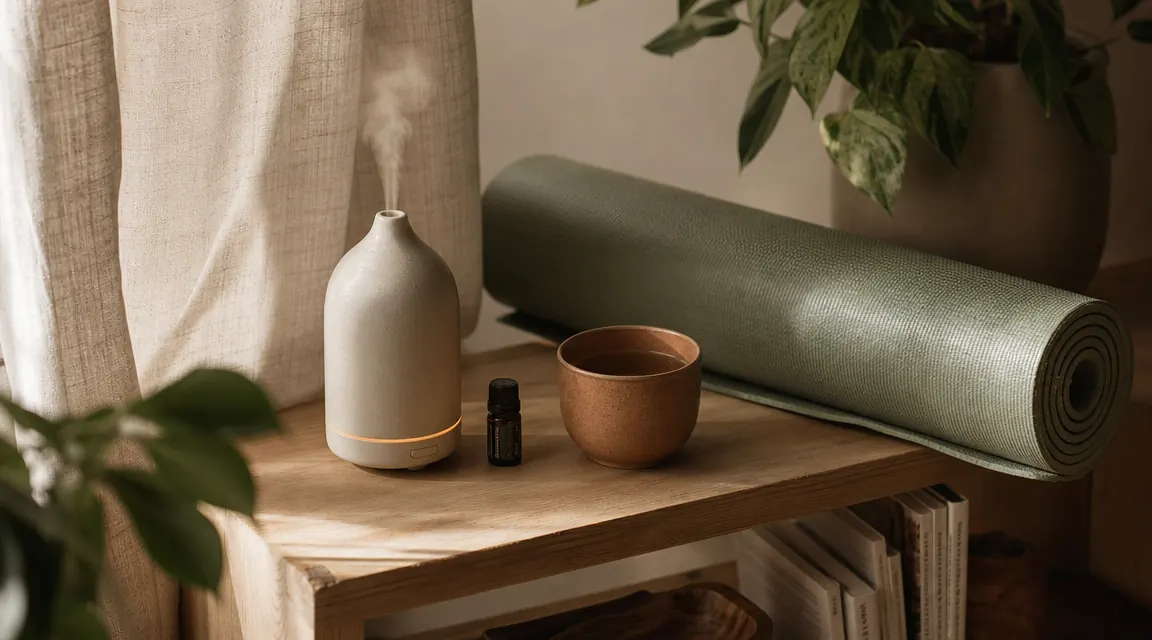
A diffuser sitting on a shelf is not a ritual. I know this from experience. I bought my first ultrasonic diffuser about four years ago, ran it for a week because lavender made my apartment smell peaceful, and then forgot it existed for six months. The bottle of lavender sat beside it, both of them untouched. What I had purchased was a pleasant-smelling object. What I had not built was a practice.
The difference between an object and a practice is context. A yoga mat leaning against the wall is furniture. A yoga mat unrolled at 6:15 every morning, before the phone comes on, before the news, before anything that wants something from you, that is a practice. Aromatherapy works the same way. The moment you attach a scent to a moment you already value, the ritual builds itself. The ASAKUKI 500ml Essential Oil Diffuser has been my daily anchor for over a year now, running through morning focus sessions, post-yoga wind-downs, and sleep preparation, and it has held up to that frequency reliably. But the diffuser is just the tool. The steps below are what make it stick.
Ready to stop buying diffusers and actually build the ritual?
The ASAKUKI 500ml diffuser is the workhorse of this framework. It runs for up to 16 hours on a single fill, has five timer settings so it fits any window in your day, and comes with a remote so you never have to get up during savasana. Over 70,000 Amazon reviews back it up.
Amazon Check Today's Price on Amazon →Step 1: Identify Your Three Ritual Windows
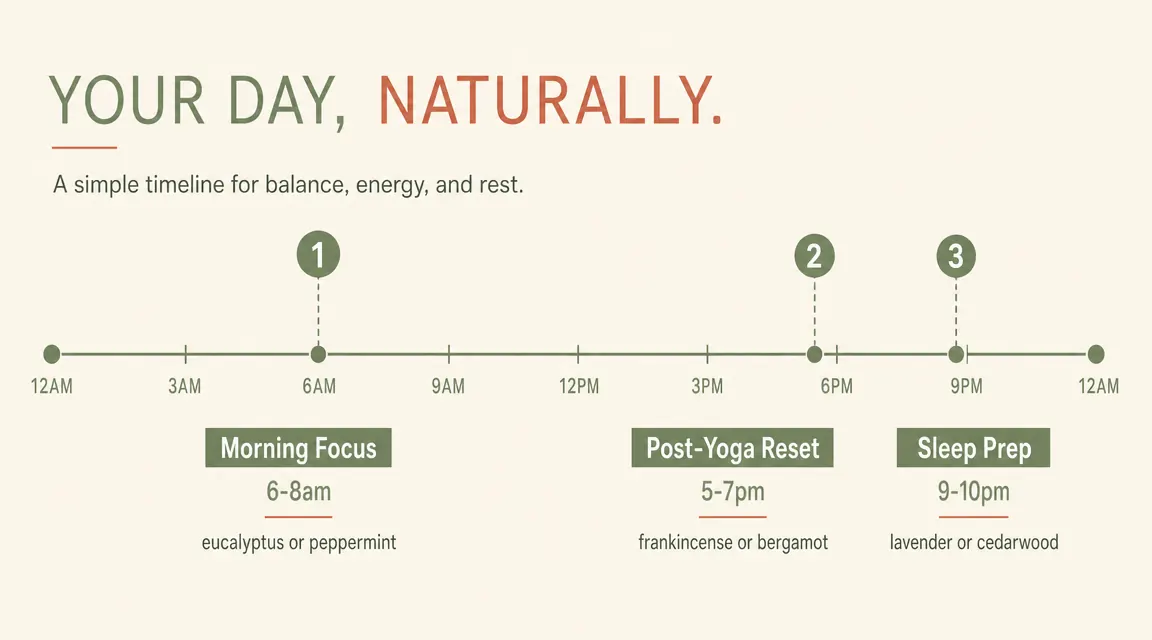
Before you choose a single oil or decide where to put the diffuser, you need to know when aromatherapy will serve your day. The answer is almost always one of three windows: morning (when you are building focus and intention), transition (the hour after work, after yoga, the buffer between doing and resting), and sleep preparation (the 30 to 60 minutes before bed). You do not have to use all three, but you need at least one to be consistent, and it has to be a window you actually protect.
I started with just one: post-yoga. My evening practice ends around 7pm and I used to spend the next two hours half-working, half-watching something, never quite landing in rest. The diffuser gave that transition a sensory signal. Frankincense on, phone down, day officially ended. Once that window was locked in, the morning window followed naturally. Pick the moment in your day when your nervous system most needs a cue, and start there.
A practical note on windows and diffuser selection: the ASAKUKI 500ml has a continuous mode and four timer settings (1 hour, 3 hours, 6 hours, and continuous). For sleep preparation, I use the 1-hour timer so it shuts off automatically. For morning focus sessions, I run it on 3 hours. Map your window length to the timer before you buy or before you start, so the tool fits the intention.
Step 2: Match Oils to Windows, Not to Moods
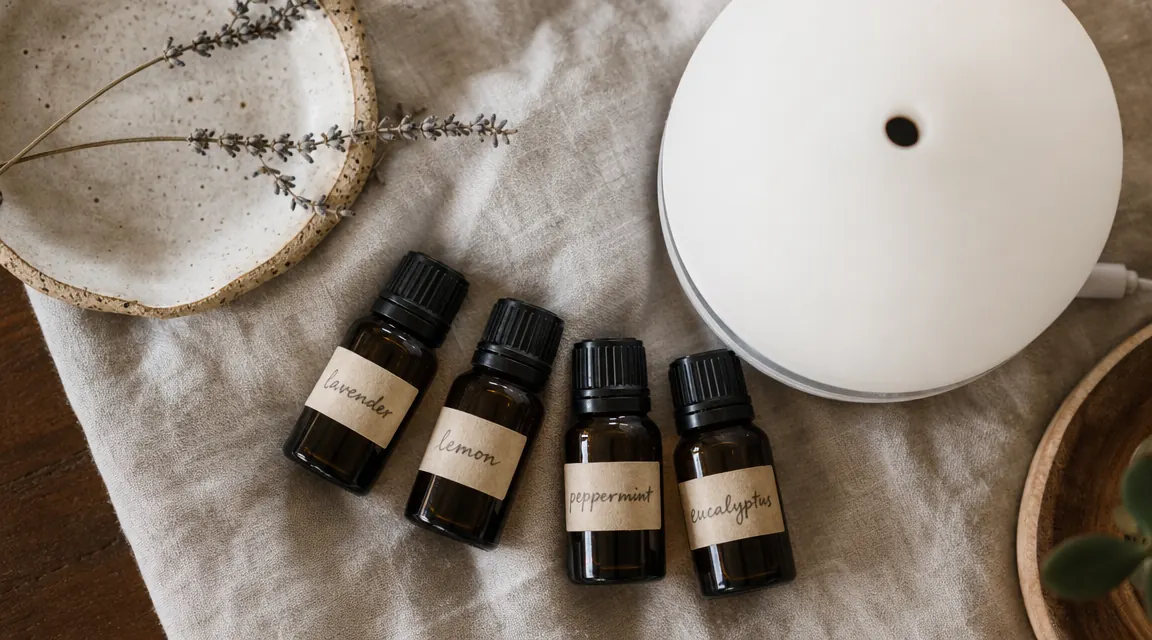
The most common mistake I see is choosing essential oils based on how you feel in the moment. Anxious today, so lavender. Tired this morning, so peppermint. That approach makes aromatherapy reactive rather than rhythmic, and rhythmic is what builds a practice. Instead, assign a small oil palette to each window and use only those oils in that window, at least for the first six weeks.
Here is what I use and why. Morning window: eucalyptus or a citrus blend like bergamot. Both support alertness without the jittery edge of caffeine, and they pair well with breathwork or pranayama before a morning flow. Transition window (post-yoga): frankincense or sandalwood. Both are grounding and slightly resinous, which gives the mind something to settle into. They have a quality I can only describe as slowing. Sleep window: lavender or cedarwood, or a blend of both. If you have practiced yoga nidra, you know the shift that happens when the body stops trying to do anything. These oils help the nervous system receive that signal.
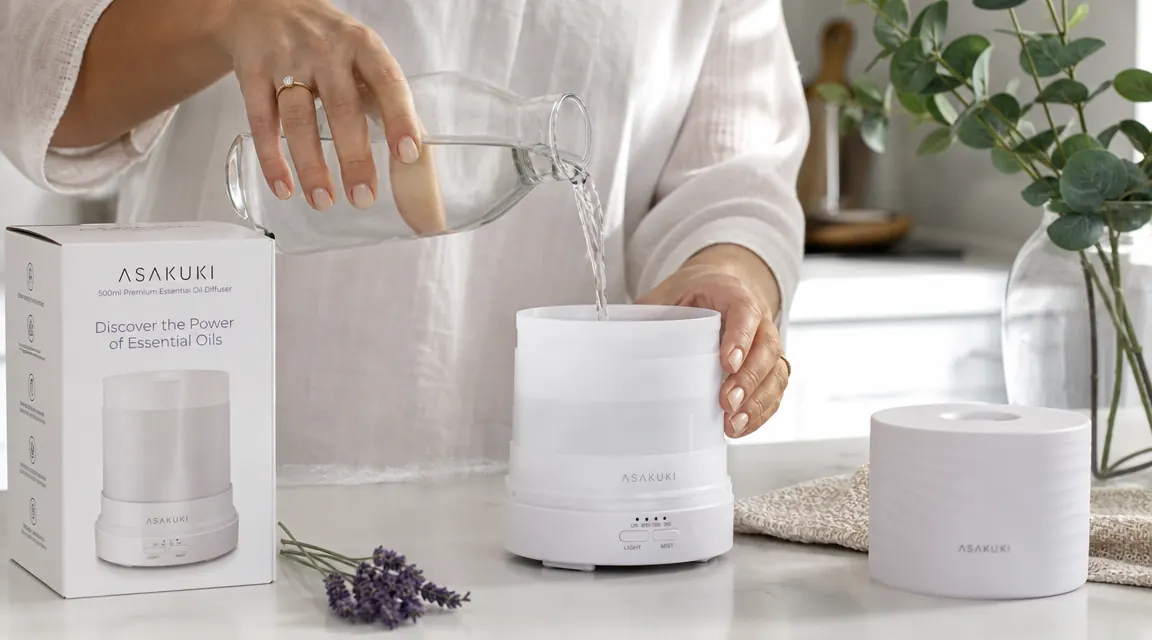
One more thing about oils and the ASAKUKI specifically: it uses ultrasonic cold-mist technology, which means it does not heat the oils. This matters because heat can alter the volatile compounds in essential oils, reducing their therapeutic quality. Cold mist diffusers preserve the oil's full profile. Use three to five drops per 100ml of water. For the 500ml tank, eight to twelve drops is a good baseline. More than that and the scent becomes heavy rather than atmospheric.
Step 3: Anchor the Ritual to an Existing Habit
James Clear would call this habit stacking. I think of it as threading. You take something you already do without thinking, something automatic and daily, and you thread the new practice through it. The diffuser turns on not because you decided to start a ritual, but because you just unrolled your mat, or because you just made tea, or because you just changed into pajamas. The existing habit carries the new one.
For morning aromatherapy, my anchor is filling the kettle. The moment I fill the kettle for my morning tea, I also fill the ASAKUKI's water tank. Both containers. Both filled. Both on. The physical motion is identical enough that one triggers the other automatically within about ten days. For the sleep window, my anchor is dimming the lights. My home has one smart bulb I put on a warm sunset setting at 9pm. The second the lights go warm, I add the oils and press the 1-hour timer. The light tells my body it is evening; the scent confirms it. Together they create a sensory environment that makes sleep feel like a natural next step rather than something I have to force.
You take something you already do without thinking and thread the new practice through it. The diffuser turns on not because you decided to build a ritual, but because you just unrolled your mat.

Step 4: Set Up the Physical Space Intentionally
Where you place the diffuser shapes the ritual. The ASAKUKI 500ml is a clean white cylinder, about the size of a large coffee mug, and it looks good on a shelf or a nightstand without announcing itself. But placement is about function first. For the morning window, I keep mine at eye level on a small shelf near my practice space, close enough that the mist moves through the room where I am working or practicing. For the sleep window, I keep a second one (yes, I eventually bought a second) on the nightstand, about an arm's length away. You do not want the mist blowing directly onto your face, and you want the LED to be out of direct sightline when you are lying down.
The ASAKUKI has seven optional LED colors and a light-off mode. For sleep, I always use light-off. For morning, I leave it on the soft amber setting, which is warm enough to feel like candlelight without being distracting. For the post-yoga transition, the blue setting has a grounding quality that pairs well with frankincense. This might sound like over-engineering a mood, but the point is that the tool has enough flexibility to fit different ritual contexts without requiring multiple devices. The remote control is a quiet convenience that matters more than it sounds: pressing a single button from your mat or from bed keeps you from breaking the state you just worked to create.
Step 5: Let the Ritual Evolve Slowly
The final step is about patience, which is not usually how how-to guides end. But any practice, whether it is yoga, meditation, or breathwork, has a period where it has not yet compounded. The first two weeks of an aromatherapy ritual feel deliberate. You are thinking about it, choosing it, sometimes forgetting it. By week four, you stop noticing the decision. By week eight, you notice when it is absent. That absence is when you know you have built something real.
The way to protect the ritual during those early weeks is to keep it simple and small. Do not start with three windows, three oils, and a full setup routine. Start with one window, one oil, and one anchor habit. I spent the first month using only lavender at bedtime, anchored to my lights dimming. Everything else came later. The ASAKUKI has enough features to grow with you, timers for longer windows, a remote for convenience, a large enough tank that a 500ml fill covers multiple days on moderate settings, but you do not need any of that sophistication on day one. You need one reliable start.
A note on maintenance, because this is where diffuser habits break down for a lot of people. The ASAKUKI requires a quick wipe of the water tank every few days and a deeper clean with white vinegar once a week or so, especially if you use citrus oils, which can leave a faint residue. Ten minutes on a Sunday. If you let that slide for more than two weeks, you may notice reduced mist output. The auto-shutoff feature protects the unit from running dry, so that part is covered. But the tank cleaning is your job. Build it into your Sunday reset if you have one.
What Else Helps
The diffuser is the primary tool, but a few supporting choices make the ritual easier to sustain. A small tray or wooden box to hold your oils prevents the decision fatigue of hunting through a cabinet at 9pm. Pre-measuring drops into tiny roller bottles (empty ones from craft stores) for each window means you only make the blending decision once a week, not every night. And keeping the ASAKUKI's water tank filled at the start of the week, rather than filling it at point of use, removes the last friction point that might make you skip the ritual on a tired Tuesday.
If you are new to essential oils entirely, start with a single high-quality lavender. It is the most studied, the most forgiving to blend, and the easiest anchor for a sleep ritual. Once that window is consistent, add a second oil for a second window. Quality matters more than variety. Four good oils used consistently will do more for your practice than twenty mediocre ones that you pick through every evening wondering what to reach for.
For further reading on the ASAKUKI's specific performance over time, including how the mist output, auto-shutoff, and LED behavior hold up after a year of nightly use, see the ASAKUKI long-term review. For ten specific ways a diffuser elevates the broader wellness ritual beyond just scent, the reasons an aromatherapy diffuser earns its place in your daily practice piece goes deeper.
One diffuser. One oil. One window. That is where the ritual starts.
The ASAKUKI 500ml Essential Oil Diffuser is well-suited to this approach. It runs quietly, the auto-shutoff removes the worry of forgetting it, and it has five timer options that match any ritual window from 30 minutes to continuous. With 70,000-plus reviews and a rating of 4.4, it is one of the most thoroughly tested diffusers at this price point.
Amazon Check Today's Price on Amazon →