
Most people buy their first yoga mat the same way they buy a dish rack. They grab whatever is nearby, at a price that does not sting, and figure it will do the job. For a while, it does. Then the grip starts to fade. The mat bunches at the corners. You catch yourself sliding in Warrior II and spending more mental energy stabilizing your hands than being present in the pose. That friction, the physical kind and the mental kind, is the signal worth listening to.
Choosing a mat for a serious practice is not about spending more money for its own sake. It is about understanding what you actually need from the surface under you, and then finding the product that delivers those things reliably over years, not months. This guide walks through every specification that matters, in the order it matters, so you can make one good decision instead of three mediocre ones.
The mat most teachers recommend after years of daily practice
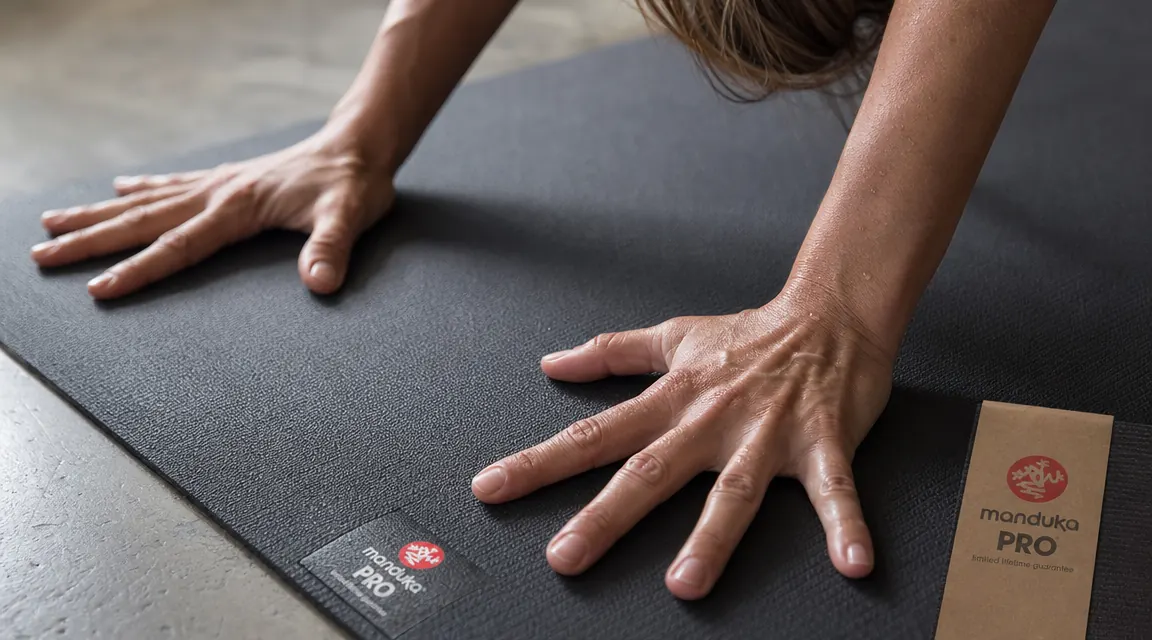
The Manduka PRO is the benchmark this guide measures everything else against. 6mm closed-cell PVC, lifetime guarantee, 4.6 stars across nearly 9,000 reviews. If you already know what you want, here is where to check the current price.
Amazon Check Today's Price on Amazon →Step 1: Decide What Kind of Practice You Are Actually Building
The first question is not about the mat. It is about you. Are you practicing five days a week in a home studio? Traveling with a mat in a carry-on twice a month? Attending a heated Vinyasa class every morning? Sitting in Yin for ninety minutes three evenings a week? The answers change every specification that follows.
A dedicated home or studio practitioner who is on the mat six or more hours a week needs durability and grip above everything else. A traveler needs portability. A hot-yoga practitioner needs open-cell rubber or a microfiber top layer because PVC becomes slick under heavy sweat. A Yin or restorative practitioner may want extra cushioning to protect hip bones and ankles in long holds. Write down your three most common practice situations before you look at a single product page.
Most people who are serious about their practice land in the same category: regular studio or home use, mixed styles, five to seven sessions per week. That profile is exactly what the Manduka PRO was designed for, which is why it shows up so consistently in conversations among experienced practitioners and teachers.
Step 2: Understand Thickness, and What It Actually Does
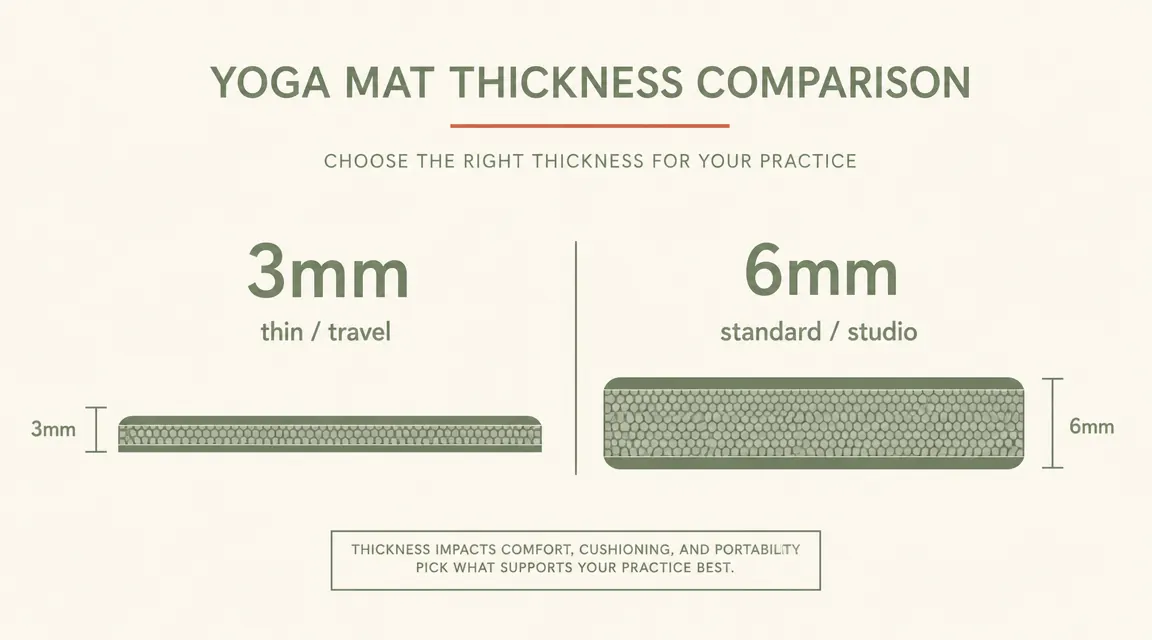
Thickness is measured in millimeters, and the standard range runs from 1.5mm (ultra-thin travel mats) through 4mm (light-use general mats) to 6mm (studio-grade) and occasionally higher for therapeutic-use mats. More thickness does not always mean more comfort. It means more material between your foot and the floor, which changes how stable you feel in standing poses.
At 4mm or thinner, you feel the floor clearly. Balance poses feel grounded because your proprioceptive feedback is high. At 6mm, there is more cushion for knees, hips, and wrists, which matters enormously in longer practices. The tradeoff is a very slight reduction in stability during precise balance work. For most practitioners, 6mm is the correct balance. It is not coincidental that the Manduka PRO, the most widely recommended mat among teachers, is built at exactly 6mm.
Avoid mats thicker than 8mm unless you have a specific therapeutic need. They tend to feel spongy, reduce proprioception significantly, and often compress unevenly over time, leaving indentations where you kneel or stand most frequently.
Step 3: Choose Your Material, and Know What You Are Signing Up For
Yoga mat materials fall into four main categories: PVC, natural rubber, TPE (thermoplastic elastomer), and cork. Each has a different feel, durability profile, and environmental footprint. Understanding the tradeoffs saves you from buying twice.
PVC (polyvinyl chloride) is the most common material in premium mats. It is dense, durable, and holds its texture for years. The Manduka PRO uses a closed-cell PVC construction, meaning the surface does not absorb sweat or bacteria, it stays on top. This makes it hygienic, easy to wipe down, and resistant to the kind of breakdown that turns cheaper mats into sticky, crumbling surfaces. The environmental argument against PVC is real but worth contextualizing: a mat that lasts fifteen years has a lower footprint per use than three mats that last three years each. Manduka backs this with a lifetime guarantee.
Natural rubber offers an excellent grip-to-cushion ratio and a more sustainable sourcing story, but it is heavy, does not do well with direct sunlight over time, and is not appropriate for anyone with a latex allergy. TPE mats are lighter, often foldable, and marketed as eco-friendly, but most do not hold up past two years of serious daily use. Cork is a good choice for hot yoga specifically because moisture actually improves cork grip, but it chips at the edges and does not offer the same cushioning as denser materials.
For a practitioner who wants one mat that does everything well for a decade, closed-cell PVC is the most defensible choice.
Step 4: Evaluate Grip Under Your Actual Conditions
Grip is where cheap mats reveal themselves fastest. A mat that feels fine in the store or during a slow flow will slide the moment your palms get warm. The grip question is really two separate questions: what is the dry grip like, and what happens when you are sweating?
Dry grip is a function of surface texture. Look for descriptions like embossed, textured, or ribbed rather than smooth-top. The Manduka PRO uses a density-layered construction with a textured surface that provides what most reviewers describe as immediate grip with a slight stickiness, the kind that keeps hands and feet placed without feeling like you are attached to the mat.
Wet grip is where mats diverge sharply. Open-cell mats (natural rubber, most TPE) absorb sweat into the surface and maintain grip. Closed-cell PVC like the Manduka PRO repels sweat, which means the surface stays drier than it would otherwise, but it also means that in very heavy-sweat practices you may want a yoga towel over the mat. This is not a design flaw. It is a material property. Most serious practitioners who use a PVC mat for hot or power yoga simply keep a Yogitoes or similar towel on hand for the highest-intensity portions of practice.
There is also a break-in period worth knowing about. The Manduka PRO, like most high-density PVC mats, has a factory finish when new that slightly reduces grip for the first ten to twenty uses. This is normal and temporary. The common break-in method is to salt-scrub the surface with coarse sea salt and a few drops of water, let it sit twenty minutes, then wipe clean. After two or three of these treatments plus regular use, the grip settles into the texture that the mat is known for.
The mat is the foundation of every pose you will ever do. Getting that right is not an upgrade. It is the practice itself.

Step 5: Factor in Weight, Portability, and Your Actual Life
Weight is the specification most people overlook until they are carrying a mat three blocks in summer. Studio-grade mats like the Manduka PRO weigh approximately 7.5 lbs. That is not light. If you commute to a studio on foot or by transit, that weight is felt daily. If you practice at home and the mat stays rolled in the corner, it is irrelevant.
The honest answer is that premium durability and low weight do not coexist well. Lighter mats are either thinner or made from less dense materials, both of which compromise the longevity and feel of a serious practice mat. The practitioners who are most satisfied with heavier mats tend to be home practitioners or those with a car. If you commute regularly to a studio, you may want to consider keeping a lighter travel mat for transport and a full-weight mat at home, or choosing a slightly lighter premium option in the 5mm rubber category.
Also consider mat dimensions. Standard mats are 68 inches long. If you are taller than 5'10", a 71-inch or 74-inch extended mat prevents your heels from hanging off the back edge in poses like Savasana, which is a small annoyance that compounds over thousands of sessions. The Manduka PRO is available in the standard 71-inch length and an extended 85-inch option.
Step 6: Read the Guarantee, Not Just the Reviews
Most yoga mats carry a one-year warranty. Some carry none. The Manduka PRO carries a lifetime guarantee, which means the company will replace it if the mat breaks down under normal use conditions. That single policy tells you something about how the brand expects the product to perform over time.
A lifetime guarantee is not marketing language when a company actually honors it at scale. With nearly 9,000 Amazon reviews and a 4.6 overall rating, the Manduka PRO has enough user data to evaluate honestly. Complaints are real and worth knowing: the break-in period surprises people who expect immediate performance, the weight is inconvenient for commuters, and the mat takes time to reach full grip potential. These are genuine tradeoffs, not defects. The things that do not appear in complaints at scale are the things that matter most: the mat does not degrade, peel, crumble, or lose its density after years of daily use.
When evaluating any mat purchase, look at the one-star reviews specifically. What are people actually unhappy about? For the Manduka PRO, one-star reviews almost always cite the break-in period or weight, both of which are documented, known, and workable. Mats with one-star reviews citing peeling surfaces, compression after three months, or slipping that appeared after light use are telling you something more fundamental about quality.
What Else Helps
A good mat works better with a few supporting choices. A mat strap or carry bag matters if you are walking to class regularly. A microfiber yoga towel extends the mat's wet-grip performance significantly in hot or power classes. A small spray bottle with a diluted tea tree or lavender solution keeps the surface clean between full washes, which for a closed-cell mat only needs to happen once a month or so with a mild soap and water wipe-down.
Storage matters more than most people expect. Rolling the mat loosely (rather than tightly) and keeping it out of direct sunlight extends the life of any mat material. PVC is particularly sensitive to heat and UV over long exposures. Keep the mat in a bag or rolled in a shaded corner rather than on a sunny windowsill.
If you are uncertain whether the Manduka PRO is the right fit before committing, reading through the detailed long-term experience in the 14-month Manduka PRO review or the full breakdown of what makes premium mats different in the 10 reasons a premium mat transforms your practice piece will give you more texture on the real-world experience.
If your mat is what stands between you and a settled practice, here is the one worth buying
The Manduka PRO checks every specification in this guide: 6mm closed-cell PVC, embossed grip surface, lifetime guarantee, available in standard and extended lengths. It is the mat I come back to recommending because it is the one that stops being a factor in your practice and starts becoming part of it.
Amazon Check Today's Price on Amazon →