

I came to gratitude journaling the way most skeptics do: after meditation alone stopped feeling like enough. My morning sits were consistent, my breath was steadier, but the anxious mental loop I carried into each day was still there by 9am. A friend handed me her copy of the Five Minute Journal by Intelligent Change and told me to try it for two weeks before forming an opinion. Two weeks became four months. What follows is what I actually noticed, organized into the ten reasons I think structured gratitude writing does something that sitting in silence cannot fully replicate.
The Five Minute Journal is the format I keep coming back to, and each item below references why its prompted structure specifically makes these shifts more likely to stick. With a 4.5-star rating across more than 17,000 reviews, it has clearly landed for a lot of people who started where I did.
If your mornings feel reactive before they feel grounded, this is where a lot of people find traction.
The Five Minute Journal by Intelligent Change uses a research-backed prompt structure to train your brain toward gratitude and intention in under five minutes. Over 17,000 reviews, rated 4.5 stars.
Amazon Check Today's Price on Amazon →It Gives Gratitude a Specific Target, Not a Vague Feeling
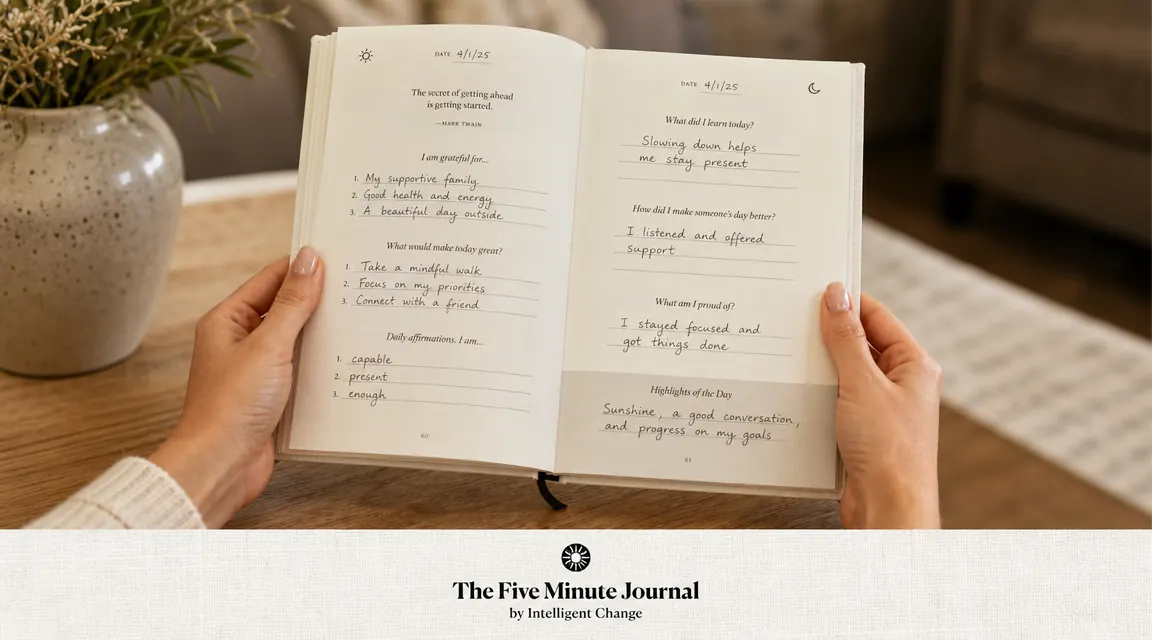
Meditation teaches you to notice. Journaling teaches you to name. When you write three specific things you are grateful for, your brain has to search for concrete evidence of good rather than settling into a general warm feeling. The Five Minute Journal prompts you to be specific each morning, and that specificity is what trains attention. Over time, your brain starts doing that search automatically throughout the day.
It Creates a Tangible Record of What Is Going Right
The negativity bias is not a character flaw. It is a survival mechanism your nervous system never got the memo to update. When you write down what is working, you create a physical archive that you can reread on the days your brain insists nothing is. The Five Minute Journal is undated, which means you can flip back through any entry and see that things were, in fact, okay on days that felt otherwise.
Morning Prompts Set a Filter for the Entire Day
The morning section of the Five Minute Journal asks you to name what would make today great. That question is not aspirational fluff. It is a filter. Once you write down three things, your attention has a heading. Research on implementation intentions suggests that naming a specific desired outcome in advance makes you significantly more likely to notice opportunities that align with it. You are, in a small but real way, priming your brain to see your day differently before it starts.
Evening Reflection Closes the Loop on Emotional Residue
Most mindfulness practices are front-loaded into the morning. The Five Minute Journal adds an evening review that asks what would have made the day better. That one question is a form of cognitive reappraisal, a technique therapists use to help people reframe negative experiences without suppressing them. Ending your day with this kind of honest, non-judgmental review tends to reduce the rumination that turns an ordinary frustration into something that lingers into sleep.
Writing it down is not the same as thinking it. When you put words on paper, you are selecting, shaping, and committing. The brain treats that differently than a passing thought.
The Prompted Format Lowers the Activation Energy to Start
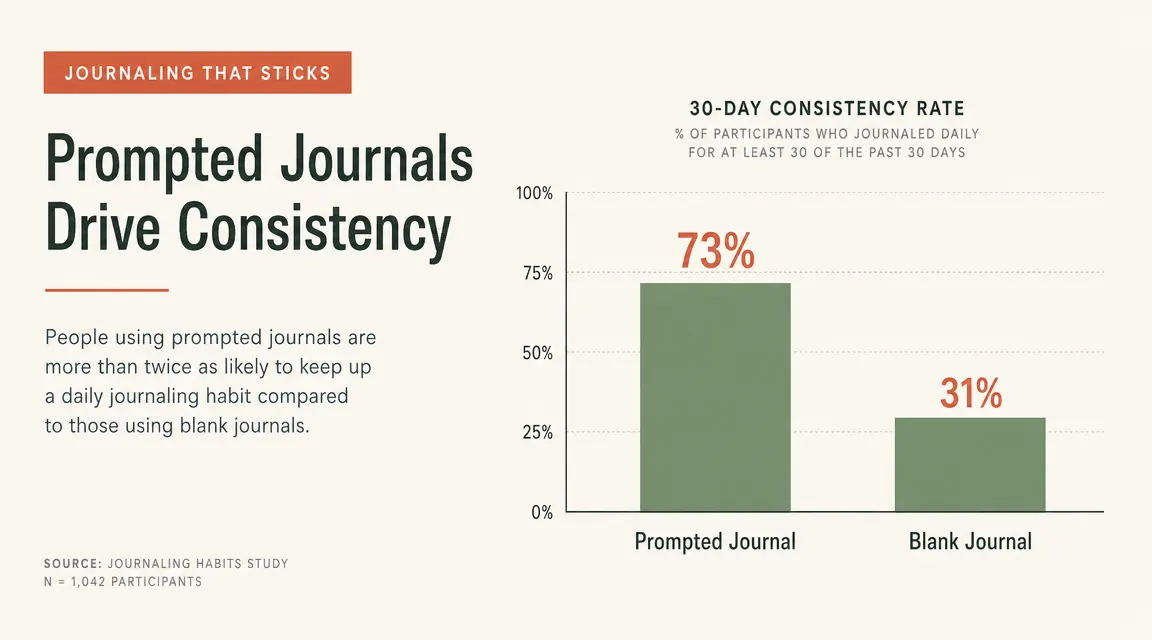
Blank journals fail because staring at an empty page is its own kind of decision fatigue. The Five Minute Journal answers the question of what to write before you sit down, which means the friction between waking up and actually completing the practice is very low. For people who know they should journal but never quite do, the prompted format removes the creative burden. You are filling in answers, not generating content from scratch.
Daily Affirmations Practiced in Writing Land Differently Than Ones Read or Heard
The Five Minute Journal includes a daily affirmation space. Writing your own affirmation, in your own words, in your own handwriting, activates a different level of ownership than reading someone else's printed on a card. Neuroscientists who study self-affirmation note that the act of writing engages motor memory alongside language processing. It is slower and more deliberate, which is exactly why it tends to feel more true.
It Pairs Naturally With an Existing Yoga or Meditation Practice
The Five Minute Journal does not compete with meditation. It complements it. Sitting practice softens the mind. Writing practice gives the softened mind something to anchor to. Many practitioners find that placing the journal at the end of their morning sit, rather than before it, lets the insight from the meditation inform what they write. The two practices reinforce each other when sequenced thoughtfully.

Consistency Over Time Builds Evidence of Your Own Capacity
There is something that happens around week six of any daily practice that no single session can produce. You look at a stack of filled pages and you have proof that you showed up, even on the mornings you did not want to. The Five Minute Journal is compact enough that five minutes genuinely is the commitment, which means the streak is actually achievable. And a streak, once it exists, tends to motivate itself.
Gratitude Writing Shifts the Default Direction of Attention
Most untrained minds scan for problems. That is the negativity bias again, doing its job from before we lived in houses. A consistent gratitude practice, especially one as structured and repeatable as the Five Minute Journal format, gradually retrains the default scan. After months of daily entries, many practitioners report noticing small positive moments during the day that they would have filtered out before. The journal does not manufacture positivity. It just stops actively suppressing the signal.
It Becomes a Quiet Anchor When Everything Else Feels Unstable
Marcus Aurelius kept his Meditations as a private journal. Not to publish, but to practice. There is something in the act of returning to the same ritual, the same prompts, the same few minutes of honest reflection, that provides continuity when life is noisy. The Five Minute Journal is undated specifically so you can begin any time and never feel behind. That design choice matters more than it sounds. It is the practice, not the calendar, that builds the steadiness.
What I Would Skip
If you are already doing 30 minutes of free-form journaling each morning and finding it rich and sustaining, the Five Minute Journal may feel redundant or too structured. The prompted format is designed for people who want a clear starting point, not for people who are already swimming in an established freewriting practice. It is also a physical book, not an app, so if your mornings are fully screen-based this adds a tactile interruption you may or may not welcome. Neither of these is a flaw. They are just worth knowing before you order.
The Five Minute Journal is not a replacement for depth. It is a container for consistency. Those are different things, and both are worth having.
Five minutes is not a small commitment. It is a sustainable one, and that difference is everything.
The Five Minute Journal by Intelligent Change uses structured morning and evening prompts to build a consistent gratitude practice. Undated, so you start when you are ready. Rated 4.5 stars across more than 17,000 reviews.
Amazon Check Today's Price on Amazon →