
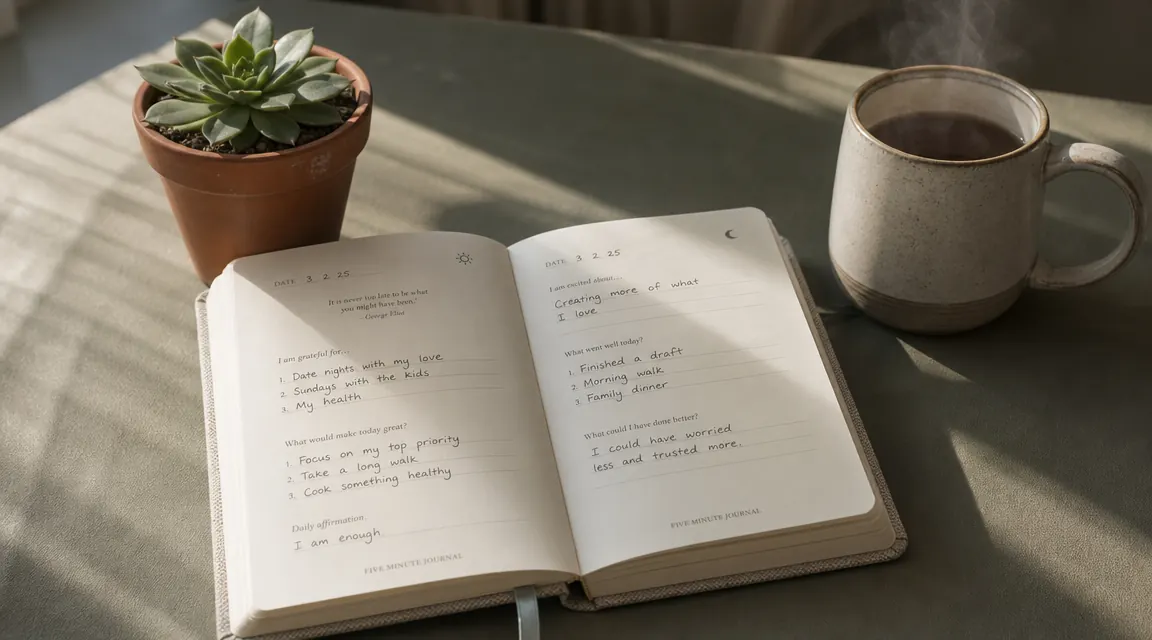
I started the Five Minute Journal by Intelligent Change on a gray Tuesday in January, three weeks after telling myself I would start a daily writing practice. I had been wanting to journal consistently for two years. I had half-filled notebooks to prove how that had been going. What changed was this: I stopped trying to find something to say and started using a journal that told me exactly what to write, every morning, in five minutes or less.
I am Sungie. I practice yoga six days a week, teach restorative flow twice a week, and think a lot about the relationship between the physical practice and the mental one. I went into this 90-day experiment genuinely curious, not looking to confirm anything. My yoga students were asking me what journaling practice I recommended alongside their savasana intention-setting. I wanted to give them an honest answer. Here it is.
The Quick Verdict
The Five Minute Journal is the most sustainable daily mindset practice I have found outside of yoga itself. The structure removes the blank-page paralysis that kills most journaling attempts, and the gratitude anchoring is genuinely difficult to dismiss after a few weeks of doing it. It is not magic. It is a reliable, low-friction daily nudge in the right direction.
Amazon Check Today's Price →If you have started and abandoned three journals already, the structure here is why this one sticks.
The Five Minute Journal by Intelligent Change uses fixed morning and evening prompts that take less than five minutes. No blank pages. No wondering what to write. 17,000+ reviews and a 4.5-star rating back the concept. Check today's price on Amazon.
Amazon Check Today's Price on Amazon →How I Used It Over 90 Days
My protocol was simple: journal first, phone second. The Five Minute Journal sat on my nightstand. Every morning before I reached for anything else, I sat up, opened it, and worked through the morning prompts. Three things I am grateful for. One thing that would make today great. A daily affirmation. In the evening, I returned for two prompts: three amazing things that happened, and one thing that could have made the day better. On weekdays this took four minutes. On foggy mornings when my mind was slow, sometimes eight. I never once spent more than ten.
I kept the journal on my mat for the first two weeks, so I would see it during my morning practice. By week three it had migrated back to the nightstand, where it lived permanently. That is where I wrote in it, sitting on the edge of my bed, before walking downstairs. I did not miss a single morning entry in 90 days. I missed four evening entries, all on travel days. That completion rate is the most honest data point I can give you.
I also photographed every week's pages so I could look back without flipping through. By week eight, I could see my own patterns. The gratitude entries in week one felt mechanical. By week five they had started to become specific. By week nine I was writing things like 'the pause before my student landed crow pose for the first time' and 'the smell of rain through the studio window at 7 a.m.' That narrowing of attention is the journal's quiet trick.

The Format and What Makes It Different
The Five Minute Journal is an undated, structured daily journal. Each day gets one page, divided into a morning section and an evening section. The morning prompts ask you to list three things you are grateful for, name one thing that would make today great, and write a daily affirmation. The evening prompts ask for three amazing things that happened and one way the day could have been better. That last prompt is the one most reviews overlook. It is not a complaint box. It is a single, contained reflection that keeps the practice honest.
The undated format matters more than it sounds. Every journal I had tried before was dated, which meant a missed day created a visible gap that felt like failure. With the Five Minute Journal, every page is a fresh start. If you miss a day, the next page is simply the next day. This removed the psychological penalty that had broken my previous attempts. Intelligent Change seems to have understood something real about habit formation: make the recovery from imperfection invisible.
The physical quality is solid. The cover is linen-textured hardback. The pages are thick enough that a wet-tipped pen does not bleed through. The binding lies flat, which matters when you are writing with one hand while holding a coffee with the other. It is not a precious art-journal. It is a functional daily tool that also looks nice on a shelf.
What Actually Changed After 90 Days
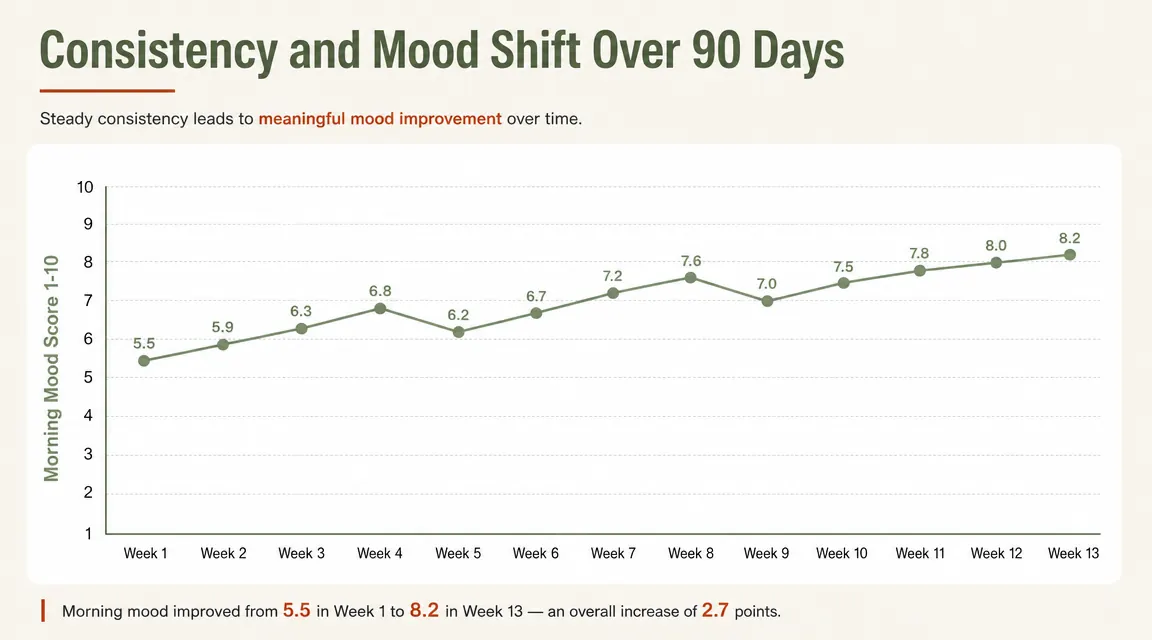
By day thirty I noticed I was spending less time in what I call the 'grievance scroll' before I got out of bed, that half-awake state where the brain catalogues everything that is wrong or pending. Writing three specific gratitudes first seemed to redirect that default scan. It did not eliminate it, but it shortened it. I started most mornings with a smaller mental debt load.
By day sixty the evening reflection had become the more useful half. The prompt asking what could have made the day better is strategically small. It is asking for one thing, not a full audit. That constraint made me more precise. Instead of vague dissatisfaction, I was identifying specific choices I had made, usually around time or attention. My yoga students started commenting around this period that my cues had gotten more specific. I think the journal was training the same precision muscle.
By day ninety the gratitude entries had shifted from recording events to recording attention. I was less likely to write 'I am grateful for my health' and more likely to write 'I am grateful for the 40 minutes on my mat this morning when nothing hurt and my balance held.' That is the quietest and most durable shift from the whole experiment. Not a larger life, just a finer focus on the one I already have.
By week nine I was writing things like 'the pause before my student landed crow pose for the first time.' That narrowing of attention is the journal's quiet trick.
Where Intelligent Change Got the Design Right
The five-minute claim is real, not marketing. I timed myself repeatedly. The prompts are short, specific, and non-open-ended. There is no 'How are you feeling today?' There is no blank section. Every prompt points at something small and concrete. This is the same reason Zen teachers give koans rather than open questions. Specificity is more generative than openness when the mind is not yet awake.
The weekly challenge prompts sprinkled throughout are a quiet bonus. Every few pages there is a one-line prompt like 'Do one thing today that your future self will thank you for.' I did not engage deeply with most of these, but the ones I did responded to stayed with me longer than the daily entries. They are conversation-starters with yourself that work best when you are already in the rhythm of the daily practice.
The introductory section at the front of the journal covers the research behind gratitude practice without being heavy-handed. It is honest about what gratitude journaling does and does not do. It does not promise a transformation. It promises a reliable shift in attention over time. That honesty calibrated my expectations correctly from day one.
What the Journal Does Not Do
It does not replace therapy, deep shadow work, or the kind of unstructured free-writing that surfaces buried material. If you are working through something significant, Morning Pages or a therapist's journal prompt set will go places the Five Minute Journal does not. The structure that makes this journal sustainable is also the structure that keeps it safe, meaning it does not invite darkness. For most people most of the time, that is the right call. For someone in a harder season, it may feel too tidy.
The affirmation prompt felt awkward to me for the first three weeks. I found 'I am capable and worthy' type statements grating. What helped was reframing the affirmation as an intention rather than a declaration. Instead of 'I am patient,' I wrote 'I will notice the moment I start to rush today.' That small reframe made the prompt useful rather than performative. The journal does not tell you this. I had to find it myself.
At 90 days, one journal is close to full. The value compounds if you continue, so the real cost is the habit of repurchase. If you are comparing this to a plain notebook and a list of prompts you write on a sticky note, the core practice is the same. What you are paying for is the friction-reducing packaging around it, and for me that packaging was worth it.
What I Liked
- Five-minute time commitment is genuinely real, not aspirational
- Undated format removes the guilt of missed days, supporting long-term consistency
- Fixed prompts eliminate blank-page paralysis completely
- Physical quality is excellent: flat-lying binding, thick pages, clean linen hardcover
- Evening reflection prompt ('what could have made today better') keeps the practice honest without becoming negative
- Weekly challenge prompts add variety without disrupting the daily rhythm
- Introductory section calibrates expectations accurately
Where It Falls Short
- Affirmation prompt requires personal reframing to feel authentic rather than performative
- Does not support deep unstructured writing or shadow work
- One journal lasts roughly 6 months of daily use, so ongoing cost adds up
- No digital option if you want to practice on travel days without carrying the book
- Structure that makes it sustainable can also feel limiting once you have built the habit and want more depth

How It Sits Alongside a Yoga Practice
Yoga teaches you to arrive before you begin. You settle on the mat, take a breath, set an intention, and only then start moving. The Five Minute Journal does the same thing for the day itself. The morning prompts are a kind of mental pranayama: three deliberate breaths in the form of gratitude, one intention for the day, one affirmation to ground the body-mind link. It is not a coincidence that the practice feels complementary to yoga rather than separate from it. They are both about attention before action.
I have started recommending it to students who ask how to take their off-mat practice seriously. Not to everyone. The students who are already drawn to intention-setting, who linger in savasana rather than rolling up early, who ask questions after class rather than heading straight for their phones. Those students tend to take to the journal immediately. It speaks the same language as their practice.
Who This Is For
The Five Minute Journal is the right tool if you have wanted to journal consistently and have not been able to, if the blank page is what stops you, or if you have a meditation or yoga practice and want something that extends that intentional quality into the rest of your morning. It is also well-suited to anyone who tends toward catastrophizing or negativity bias and wants a low-drama daily practice for redirecting that default without feeling like they are forcing positivity. The constraint of the prompts does that work quietly.
Who Should Skip It
Skip it if you are a deep writer who needs space to follow a thought wherever it goes. The five-minute structure will feel like a leash. Skip it if you find gratitude-focused framing philosophically grating and are not willing to reframe the prompts for yourself. And skip it if you are looking for a clinical tool for anxiety or depression management. This is a wellness practice, not a therapeutic intervention. For those needs, the research on expressive writing or cognitive journaling points to different formats. If you are curious about how the Five Minute Journal compares to an unstructured approach, I have written directly on that question in Five Minute Journal vs Morning Pages.
90 days in, the practice is the part of my morning that is hardest to skip, not easiest.
The Five Minute Journal by Intelligent Change has 17,500+ reviews and a 4.5-star rating. It is undated, structured, and takes less than five minutes per day. If you have tried journaling before and it has not stuck, the format here is a different approach. Check today's price on Amazon and read the look-inside pages before deciding.
Amazon Check Today's Price on Amazon →