

If you have spent any time in wellness spaces, you have probably heard both names. Julia Cameron's Morning Pages, the practice from The Artist's Way of writing three longhand pages first thing every morning, has been a fixture in creative and spiritual circles since 1992. The Five Minute Journal by Intelligent Change launched in 2013 and has since sold hundreds of thousands of copies, drawing a loyal following among the productivity-minded, the yoga-adjacent, and the anyone-who-tried-journaling-and-quit crowd. Both involve writing. Both happen in the morning, ideally. But they are solving fundamentally different problems.
I have done both. Not casually, not a week each. I kept Morning Pages for six weeks during a particularly fractured stretch of my life, when I needed somewhere to put the noise. Then I switched to the Five Minute Journal, which I have used consistently for just over three months now. The difference in what each practice produces is not subtle. It is not even a matter of preference, really. It is a matter of what you are trying to do with your mornings.
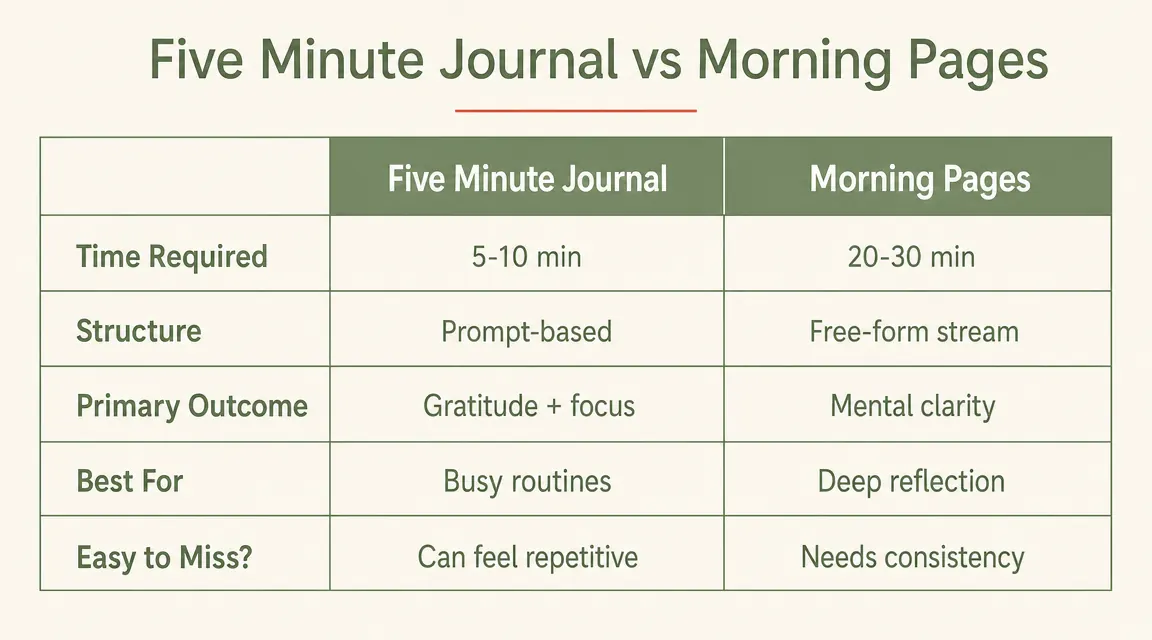
| attribute | left | right | |
| attribute | left | right | winner |
| attribute | left | right | winner |
| attribute | left | right | winner |
| attribute | left | right | winner |
| attribute | left | right | winner |
| attribute | left | right |
Where the Five Minute Journal Wins
The Five Minute Journal wins on one thing above all else: it removes the blank page. Every morning, you are met with the same five prompts. Three things you are grateful for. What would make today great. A daily affirmation. In the evening, three amazing things that happened, and one thing you could have done better. That is the whole structure. It sounds almost too simple. But that simplicity is load-bearing.
Most journaling practices fail not because people lose interest but because they run out of steam at the blank page. The Five Minute Journal sidesteps that entirely. The prompts do the cognitive work of starting. You just fill in the blanks, and somewhere in that filling-in, your nervous system begins to orient toward what is good and intentional about the day rather than what is uncertain or draining. Neuroscience research on gratitude suggests that the act of naming three specific things you are grateful for, done consistently, begins to rewire attentional bias over weeks. You start noticing more things worth noting. That is not a small outcome for five minutes.
The physical journal is also worth mentioning. It is undated, which removes the guilt of a skipped day. The paper quality is substantial. The cover is cloth-bound and holds up to daily handling without looking worn after a month. These things matter more than they seem. A journal that feels like a ritual object becomes one.
If your mornings are already full and you want one grounding practice that takes less time than a cup of tea, this is it.
The Five Minute Journal by Intelligent Change is undated, cloth-bound, and built on over a decade of research into gratitude and positive psychology. Rated 4.5 stars by more than 17,000 readers on Amazon.
Amazon Check Today's Price on Amazon →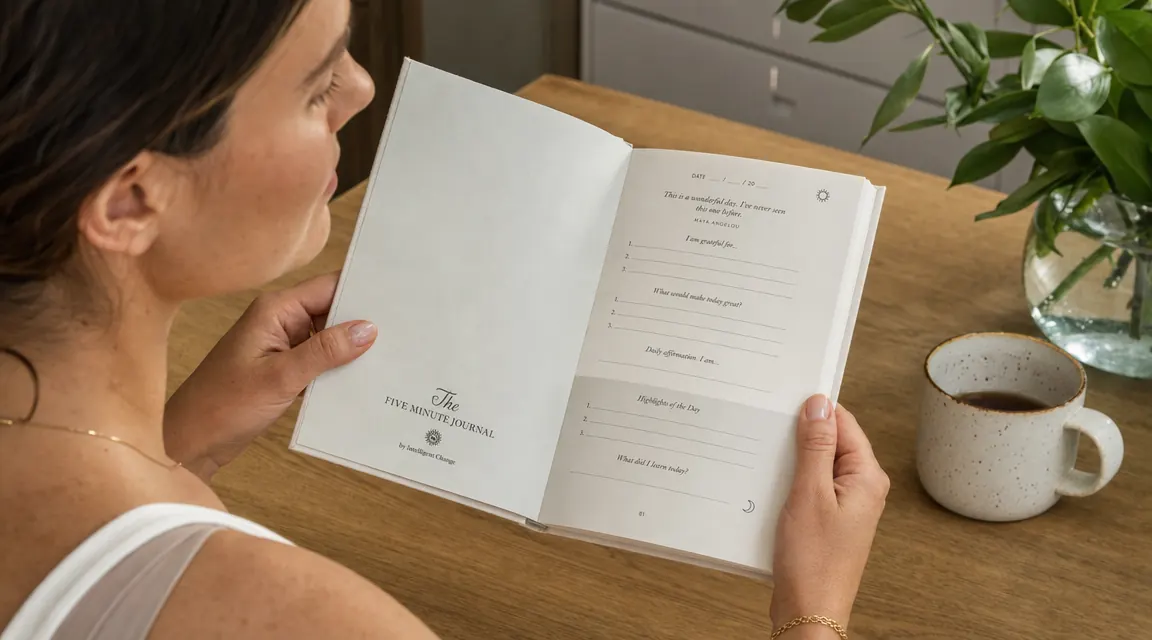
Where Morning Pages Wins
Julia Cameron designed Morning Pages to clear the channel. Her premise in The Artist's Way is that we carry a constant stream of mental noise, anxieties, petty grievances, half-formed ideas, lingering conversations we wish had gone differently, and that this noise blocks creative and spiritual clarity. The three pages of longhand writing every morning are not supposed to be good. They are not supposed to be meaningful. They are supposed to get the noise out before it colors the rest of your day.
For people who are processing something large, a breakup, a career pivot, a grief, or a creative block they cannot name yet, Morning Pages can be genuinely revelatory. There is something in the physical act of longhand writing, slower than typing, less censored than speaking, that surfaces things you did not know you were carrying. I found this to be true during my six weeks with the practice. I wrote things in those pages that I had not consciously acknowledged, thoughts that had been shaping my behavior without my awareness. That is the gift of an unstructured format. It goes where you cannot plan.
Morning Pages clear the channel. The Five Minute Journal orients the compass. Both are valuable. The question is which one your mornings can actually hold.
The Consistency Problem, and Why It Matters
Here is where I want to be direct, because I think a lot of wellness writing glosses over this. Morning Pages are hard to keep. Not emotionally hard, though they can be that. Logistically hard. Thirty to forty-five minutes of handwriting before anything else, every morning, for weeks and then months, is a significant commitment. Julia Cameron is clear in her writing that the practice requires commitment. She does not apologize for the time it takes. And she is right that the benefits compound with consistent practice.
But most people's mornings do not have thirty-five minutes of unallocated stillness in them. If you have children, a commute, a yoga practice, a job that starts before eight, or a body that does not wake up easily, Morning Pages will get crowded out. And when they get crowded out two or three days in a row, the momentum breaks in a way that is hard to restart. The blank page, without any prompts, is unforgiving when you return to it after a gap.
The Five Minute Journal does not have this problem. You can miss a day, pick it up the next morning, and the practice is immediately intact. The prompts reset it. The undated pages mean there is no visual record of the gap. That sounds like a small mercy, but for most people it is the difference between a practice that lasts six weeks and one that becomes a genuine habit.

Who Should Buy Which
If you are drawn to Morning Pages, I want to honor that instinct. It is a practice with real depth and a long lineage. If you are in a season of life where you have time and something to process, if you are a writer or creative person who works through things on the page, if you have done the Artist's Way and want to recommit, then Morning Pages will serve you in ways a prompted journal cannot. Buy a good plain notebook, commit to twelve weeks, and do not skip the accompanying tools Cameron recommends alongside the pages.
If, however, you are someone who has tried journaling before and abandoned it, who wants a morning anchor that takes less than ten minutes and produces measurable mindset shifts, who practices yoga or meditation and wants something that complements those practices rather than competing with them for time, then the Five Minute Journal is the more sustainable choice. It is also, frankly, the more researched one, in that its prompts are built on the positive psychology literature around gratitude, intentionality, and self-reflection, rather than on intuitive creative wisdom alone.
The honest short answer: most people reading this will do better with the Five Minute Journal. Not because Morning Pages lacks value, but because the barrier to entry is lower, the consistency is higher, and the outcomes, while narrower, are more reliably achieved. A practice you keep for three months is worth more than a practice you admire and abandon after three weeks.
Three months of five-minute mornings will shift how you start every day. The research is behind it and so is the design.
The Five Minute Journal is undated, cloth-bound, and trusted by over 17,000 Amazon reviewers. It pairs naturally with a yoga or meditation practice as a pre-mat or post-mat ritual. No blank page, no pressure, no skipped-day guilt.
Amazon Check Today's Price on Amazon →