

A note from Sungie: this is the story of how the Five Minute Journal rewired my mornings, and why I no longer reach for my phone before my pen.
For three years my alarm went off and my hand went straight to my phone. Not consciously. It was reflex, the way you reach for a railing in the dark. I would tell myself I was just checking the time, and then fourteen minutes would vanish into a scroll that left me vaguely unsettled before I had even sat up. I knew it was a problem. I had known it for a long time. I had tried screen timers, app blockers, a grayscale display setting, and one ambitious week where I put my phone in a different room entirely. None of it stuck for more than a few days. The pull was just too habitual, too automatic.
I practice yoga most mornings, and for a long time I thought my mat was enough. Get to the mat early enough and the phone loses. But the truth is, I was often getting to my mat already frayed, already carrying whatever I had absorbed in those first few minutes of scrolling. My practice was good, but I was bringing noise into it. A teacher I respect said once that what you do in the first five minutes after waking sets the nervous system's tone for the whole day. I had heard that sentence maybe a dozen times. I had never actually taken it seriously.
A friend mentioned the Five Minute Journal at dinner one night, almost as a footnote. She said she had been doing it for four months and that it had become the thing she protected most in her morning. I filed it away as one of those tidy productivity-adjacent things that works for some people and not others. Then I had a particularly rough week, the kind where anxiety sits on your chest before you have any conscious reason for it, and I ordered it without overthinking.
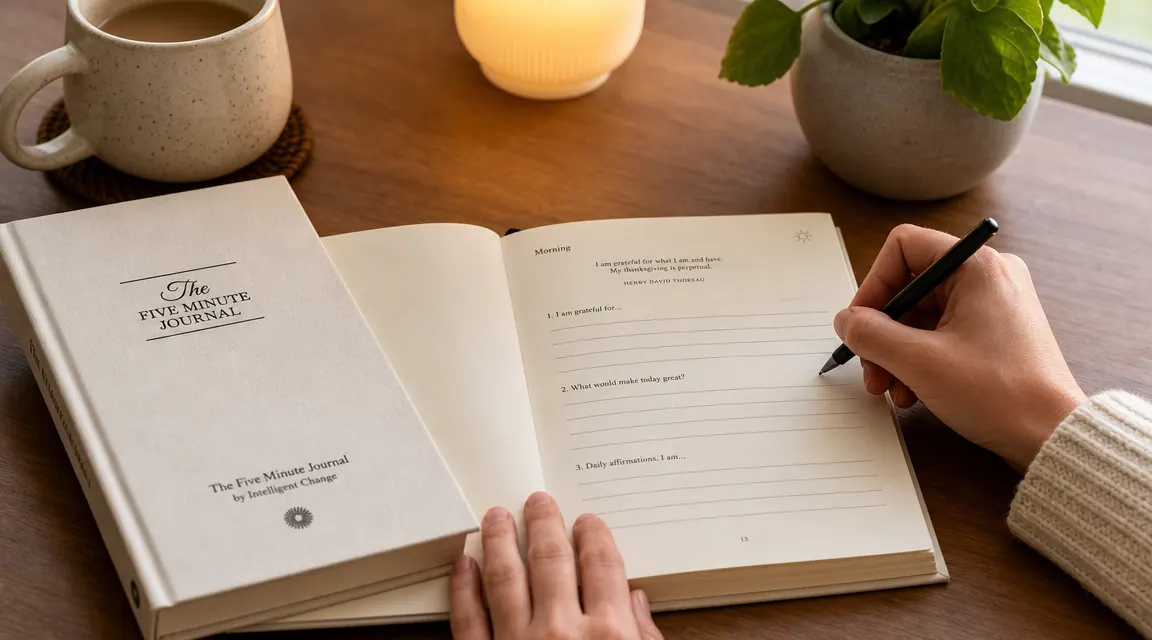
The Five Minute Journal by Intelligent Change is a structured undated daily planner. That word, structured, is the important one. It is not a blank page where you are supposed to pour out your feelings with no container. The morning section has three prompts: three things you are grateful for, three things that would make today great, and a daily affirmation. The evening section has two: three amazing things that happened today, and one way the day could have been better. That is it. Five questions total. Deliberately simple, deliberately short.
The structure is the whole point. A blank page asks you to figure out what to say. A prompt just asks you to answer.

The first morning, I sat on the edge of my bed with the journal in my lap and wrote three things I was grateful for. Sunlight through the curtains. Strong coffee. The fact that my cat had slept through the night without bothering me. They felt small, almost silly. But writing them took less than ninety seconds, and something about the act of writing by hand, slowly, with intention, created a pause that the phone never had. I did not feel transformed. I felt slightly more awake, and slightly less like I needed to check anything.
By the end of the first week, I noticed the journal was sitting on my nightstand and my phone was still face-down on the charger when I reached for it. By the end of the second week, the morning section had started to bleed into how I framed the rest of the day. Writing what would make today great is a deceptively functional exercise. It forces you to name something specific. Not a vague good day, but a real thing, a real conversation, a real piece of work you want to finish. It is a quiet form of intentionality, and it takes about forty-five seconds.
If your mornings feel reactive before they even start, this is the simplest intervention I have found.
The Five Minute Journal is undated, so you can start any day and miss days without guilt. It sits at 4.5 stars across more than 17,000 reviews, and the build quality is genuinely nice. Thick paper, a lay-flat spine, a cloth bookmark. It feels like something worth keeping.
Amazon Check Today's Price on Amazon →I want to be honest about what it does not do. It does not fix anything structural. If you are dealing with something serious, five gratitude prompts are not going to resolve it. On harder mornings, the journal can feel hollow. Writing that you are grateful for coffee and sunlight when you are genuinely struggling has, on a few occasions, felt slightly absurd. The evening reflection is sometimes skipped entirely. There are weeks where the morning section is the only section I use, and even those entries are spare. The journal holds all of that without complaint, because it is undated and unpressured.

What it does do is give the first five minutes of the day somewhere to go that is not a feed. That is not a small thing. The neuroscience on morning cortisol and attention states suggests that the first twenty minutes after waking shape the emotional register of the rest of the day more than most people realize. I am not citing a specific study here because I am not a researcher. I am a person who has practiced this for long enough to notice the difference in my body on mornings I write in it versus mornings I do not. My practice feels cleaner on the days I journal first. My concentration in held poses is slightly better. I am less likely to carry ambient anxiety onto my mat.
What I Would Tell You If We Were Sitting at My Kitchen Table
I would tell you to ignore the word gratitude if it makes you cringe. I understand why it does. The self-help industrial complex has wrung that word until it sounds like a performance. But writing down three specific things every morning is not a performance. It is a sorting mechanism. You are training your attention to notice what is actually present, rather than defaulting to what is missing or looming. That is a yoga principle applied to the mind before you have even reached the mat.
I would also tell you to be realistic about consistency. I have been using this journal for about sixty days. I have missed maybe nine or ten mornings. On some entries, my handwriting is barely legible because I did it half-asleep. The journal does not care. What I have found is that the habit is stickier than I expected because the commitment is genuinely small. Five minutes. Three things. One intention. Compared to every ambitious morning routine I have attempted and abandoned, this one has survived because it asks almost nothing of me.
If you are looking for something that sits at the intersection of your practice and your daily life, something that creates a pause between sleeping and everything else, the Five Minute Journal by Intelligent Change is the most reliable tool I have found for that. It is not magic. It is a structure. But sometimes a good structure is exactly what a wandering morning needs.
Start the first morning with no pressure. It is undated for a reason.
The Five Minute Journal makes a genuinely good gift too, if you have someone in your life who would roll their eyes at the word gratitude but secretly needs this. The physicality of it matters. Paper and pen in the morning land differently than a phone app ever could.
Amazon Check Today's Price on Amazon →