

Let me tell you what I actually thought when I opened the Five Minute Journal by Intelligent Change for the first time. The introduction starts with a quote from G.K. Chesterton about gratitude, followed by a promise that five minutes of daily writing will shift my mindset, improve my relationships, and help me achieve my goals. I set it down on my nightstand and did not pick it up for four days. That is how much the self-help packaging put me off.
I practice yoga most mornings. I sit in meditation. I read Marcus Aurelius and find his meditations more useful than most wellness books, partly because he is not trying to sell you anything and partly because he is honest about how hard it is to be a decent human being. Gratitude journaling, with its chirpy prompts and 'amazing things that happened today' framing, felt like the opposite of that tradition. And yet. Seventeen thousand reviews on Amazon. A 4.5-star rating. Students asking me weekly what journaling practice I recommend. I owed it a real test.
The Quick Verdict
It works, but not in the way the marketing suggests. The gratitude prompts are less important than the consistency habit they build. The evening reflection is underrated by almost every review you will read. And the affirmation prompt, which I almost used as a reason to quit, turned out to be the most interesting part once I stopped doing it wrong.
Amazon Check Today's Price →If the 'gratitude journal' label puts you off the same way it put me off, read the honest breakdown below before you decide.
The Five Minute Journal by Intelligent Change has 17,500+ Amazon reviews and a 4.5-star rating. It is undated and structured, which matters more than any of the prompts. Check today's price on Amazon and make your own call.
Amazon Check Today's Price on Amazon →What Almost Made Me Quit in Week Two
The affirmation prompt. Every morning, after listing three gratitudes and identifying one thing that would make the day great, the Five Minute Journal asks you to write a daily affirmation. The examples in the introductory section include things like 'I am worthy of love and success' and 'I radiate positivity.' I wrote 'I am a patient and attentive teacher' on day one, felt like I was lying to myself, and very nearly closed the book and donated it.
What I did instead was think about why it felt dishonest. The problem was not the concept of an affirmation. The problem was the declarative form. Saying 'I am patient' when I had just snapped at my partner over the coffee grinder is not affirmation, it is fiction. But there is a different relationship with the prompt available if you use it as an intention rather than a declaration. 'Today I will pause before responding to the thing that frustrates me.' That felt true. It also turned out to be useful. I stayed because of that reframe, not because the journal told me how to make it.
No review I read before buying mentioned this. Everyone described the affirmation prompt as a feature. No one described the friction of actually writing it with any honesty. I am telling you because if you are the kind of person who finds performative positivity grating, that friction is real and you will need to work around it. The journal does not coach you through it.
What Nobody Tells You About the Evening Prompts
The Five Minute Journal has two sessions: morning and evening. Most reviews focus entirely on the morning section, as though the evening one is optional. It is not optional. It is, in my experience, the more important of the two, and the one that the marketing undersells almost completely.
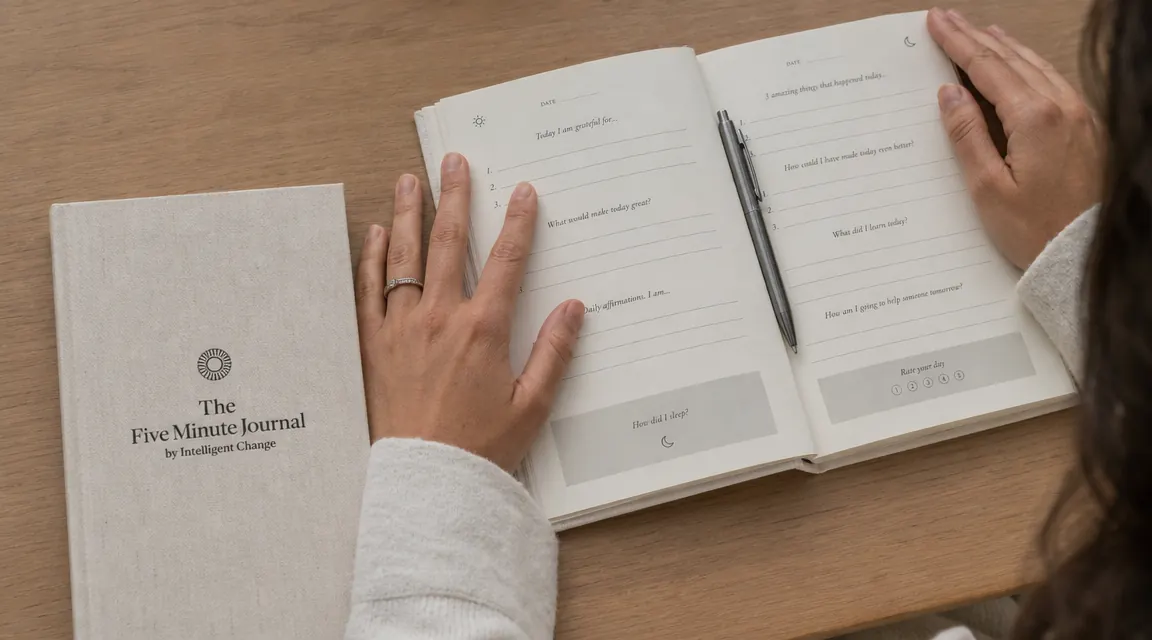
The evening section asks for three amazing things that happened during the day, and then one thing: how could today have been even better? That final prompt is strategically narrow. It does not ask what went wrong. It does not open a wound. It asks for one specific improvement, which means you are forced to be precise rather than spiral. I started using it as a closed audit rather than a complaint, and within three weeks it had started shaping the following morning's intention prompt. The two halves of the day began talking to each other through the journal in a way I had not anticipated.
My resistance to the journal came almost entirely from the morning section. The evening section I had no problem with from day one. It is harder to feel cynical about a prompt that asks you to identify one concrete thing you would do differently. That is just honest reflection. If Intelligent Change had led with that prompt in their marketing, they would have reached a different reader. Probably me, sooner.
The Gratitude Prompts: What Skeptics Get Wrong About Them
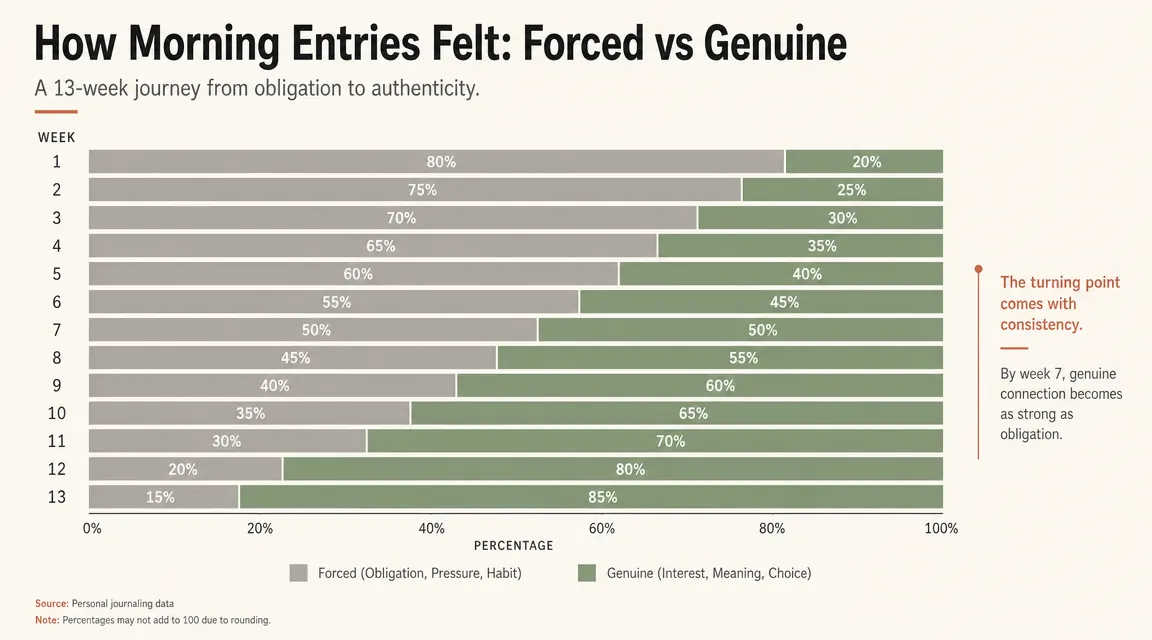
Here is what I expected: that listing three things I was grateful for every morning would feel like a rote exercise that gradually wore me down. Here is what actually happened. The first two weeks, yes, it was rote. I wrote things like 'my health, my home, my yoga practice.' Generic. Unchallengeable. Forgettable. But the prompt asks for three things, every day, which means by week three I had used up the obvious ones. I started having to look harder.
That harder looking is the mechanism. It is not that writing 'I am grateful for my health' every morning makes you healthier or happier. It is that running out of easy answers forces your attention into finer detail. By week five I was writing things like 'the way the studio smelled like rain this morning before the 6 a.m. class started' and 'the student who stayed to fold blankets without being asked.' That is not gratitude as a mood. That is attention as a practice. It is the same attention that good yoga teaches, and it turns out a five-minute writing prompt can train it as reliably as breath work.
By week three I had used up the obvious gratitudes and started having to look harder. That harder looking is the whole mechanism.
The Physical Product: Honest Notes
The Five Minute Journal is a hardcover book with a linen-textured cover and thick cream pages. It lies flat when open, which is a practical necessity rather than a luxury. The page thickness means ink from a roller pen does not bleed through, though I switched to a ballpoint after week one because the thicker ink felt more deliberate for short entries. The journal is undated, meaning each page has a space for you to write the date rather than a printed one. This turns out to matter a great deal to the habit.
Every previous dated journal I had tried made a missed day visible in a way that felt like an indictment. A blank Tuesday surrounded by filled Monday and Wednesday pages. The undated format removes that. If you miss a day, the next page is simply the next day. The blank is invisible. For a skeptic who expected to find reasons to quit, the removal of this particular exit ramp was more significant than I initially gave it credit for.
One journal covers roughly six months of daily use. That means this is a recurring purchase if you continue the habit, which is worth knowing upfront. The question of whether that ongoing cost is reasonable is a personal one. What I can tell you is that by month three, the journal had become cheap compared to what I would have spent on the same attention-building benefit from any other source.
Where the Journal Falls Short
The Five Minute Journal will not meet you in a hard season. The prompts are designed for maintenance, not crisis. 'Three amazing things that happened today' is a genuinely useful question when life is ordinary. It becomes an awkward question when a parent is in the hospital or a relationship is ending. The journal has no mechanism for sitting with difficulty. It redirects it. For most days, that is exactly right. For the days when redirection feels like a betrayal of what is actually happening, you will need something else.
The weekly reflection prompts scattered through the book are hit or miss. Some of them are pointed and useful. Others read like they were written to fill space. 'What would you do if you knew you could not fail?' showed up in week seven and I wrote nothing in the space because I genuinely did not know how to answer it without writing something I would be embarrassed by later. I left those prompts blank without guilt. The daily structure is strong enough that skipping an occasional supplementary prompt does not destabilize the habit.
There is no digital version. This matters on travel days. I carry a physical journal everywhere, so this was not a dealbreaker for me, but if your practice depends on your phone being the anchor point, this journal will require a workaround. The physical object is both the limitation and the point.
The other limitation worth naming is what the journal does not surface. If you are someone who processes emotions by writing through them, the structured prompts will feel like they are cutting you off mid-sentence. The format is optimized for brevity and forward momentum, not excavation. Stoic philosophy draws a distinction between what is in our control and what is not. This journal keeps you squarely in the first category. That is a feature, not a bug, for most people most of the time. But if you need the other kind of writing, this is the wrong tool.
What I Liked
- Undated format removes the visible evidence of missed days, which extends streaks rather than breaking them
- Evening reflection prompt is genuinely useful and dramatically underrated by most reviews
- Gratitude prompts work differently than advertised: not by mood uplift but by forcing finer attention over time
- Physical quality is practical: flat-lying binding, page thickness, and a cover that survives a bag
- Five-minute time claim is accurate even for slow mornings
- Structured enough that you never face a blank page, but not so rigid that the entries feel identical day to day
- Running out of easy gratitudes by week three forces a productive shift in how you look at the day
Where It Falls Short
- Affirmation prompt requires personal reframing to feel authentic rather than performative, and the journal does not explain this
- No mechanism for sitting with difficulty: the prompts redirect rather than process
- Weekly reflection prompts are uneven in quality and occasionally feel like filler
- Ongoing repurchase cost is worth knowing upfront since one journal lasts roughly six months
- No digital version for travel or phone-first practitioners
- Marketing positions it as a positivity tool, which undersells the evening reflection and alienates skeptics who might benefit most

How This Compares to Just Using a Plain Notebook
I have tried this comparison honestly because it is the objection I started with. Yes, you can write the Five Minute Journal prompts in any notebook. Print them on a card and tape it to the inside cover. The prompts are not proprietary. What you lose without the dedicated journal is the physical object as a commitment device. Habit research is consistent on this: friction reduction matters more than motivation. Having a separate, specific object for the practice reduces the decision load to zero. The notebook you already use for notes and lists does not create the same psychological separation.
That said, the difference is real only if you are the kind of person who respects physical containers. Some people are. I am. If you treat all notebooks the same regardless of their purpose, the dedicated journal offers less value. Know which kind of person you are before spending the money.
Who This Is For
The Five Minute Journal is right for you if you have a consistent problem with blank-page paralysis, if you need the accountability of a specific dedicated object rather than an open notebook, or if you are drawn to the idea of a mindfulness practice that does not require you to sit still. It is well-suited to practitioners who already have a yoga or meditation foundation and want a written complement to that work. The prompts speak the same language as intention-setting. You will recognize the framework from your mat.
Who Should Skip It
Skip it if you are a committed free-writer who needs space to follow a thought without guardrails. The structure here will feel constricting rather than liberating, and there are better tools for that kind of writing. Skip it if you are in a genuinely difficult period and need a practice that can meet complexity rather than redirect it. And skip it if you find the gratitude-positivity framing so philosophically objectionable that you cannot reframe the prompts yourself. The journal will not do that work for you. If you want to understand how the Five Minute Journal compares to an unstructured morning writing practice, I have written that comparison directly in Five Minute Journal vs Morning Pages. And if you are still deciding whether a gratitude practice is worth pursuing at all, the 90-day long-term review gives the fuller picture of what the habit compounds into over time.
Ninety days in, my biggest surprise was that the skeptic in me ran out of objections around week six.
The Five Minute Journal by Intelligent Change has 17,500+ reviews and a 4.5-star rating on Amazon. It is undated, structured, and designed for people who have tried journaling before and could not make it stick. The evening prompts alone are worth the price of admission. Check today's price and decide from there.
Amazon Check Today's Price on Amazon →