

Most morning routines do not fail because the person is lazy. They fail because the routine asks too much, too soon, with no architecture holding it in place. You set the alarm for 5:45 am, plan to journal, meditate, do a full yoga flow, and drink sixteen ounces of water before you check your phone. Three days in, the alarm feels cruel. By day ten, you have quietly stopped. The journal sits on the nightstand collecting a light layer of guilt.
This guide is about building something smaller and more honest, something that fits inside the life you actually have rather than the aspirational one you imagine on Sunday evening. The anchor for this ritual is the Five Minute Journal by Intelligent Change, which pairs naturally with a short yoga practice and asks almost nothing of you except that you show up and write a few sentences. That is, as it turns out, exactly enough.
If your mornings feel like they belong to everyone else, this journal gives them back to you.
The Five Minute Journal by Intelligent Change is structured, undated, and designed to take less than five minutes. It is the most consistent gratitude practice I have found for people who do not consider themselves journalers.
Amazon Check Today's Price on Amazon →Step 1: Decide What You Are Actually Protecting
Before you buy a journal or set an alarm, spend two minutes with this question: what is the one thing the morning protects? For some people it is stillness before the noise of the day. For others it is a sense of authorship, a feeling that the first hour belongs to them before it belongs to email, children, or deadlines. Knowing your answer determines everything that follows, including how long your ritual needs to be and what you are willing to defend it against.
Write your answer on the inside cover of your journal on day one. Not as a goal, but as a reminder. Marcus Aurelius began his Meditations with observations about what each person in his life had taught him, a kind of gratitude exercise before the practice had a name. The purpose was orientation. He wanted to know what he was pointing toward before he moved. You are doing the same thing.
The Five Minute Journal is undated, which matters more than it sounds. An undated journal does not punish you for missing a day. There is no skipped page staring at you, no visual record of failure. You simply pick up where you left off, which removes one of the most common reasons people abandon journaling entirely.

Step 2: Attach the Journal to Something You Already Do
Habit research consistently shows that new behaviors survive best when attached to existing anchors. The anchor is already happening, so the new behavior gets to ride along instead of fighting for its own foothold. For a yoga practitioner, the anchor options are obvious: the moment you unroll your mat, the first sip of morning tea, the transition from your yoga flow to savasana, the few quiet minutes before you check your phone.
The simplest pairing that works consistently is this: journal first, yoga second. The Five Minute Journal morning prompts, what you are grateful for, what would make today great, and a daily affirmation, take about three minutes when you are not overthinking them. They warm up your mind in the same way that cat-cow warms up your spine. By the time you step onto your mat, something has already shifted. You are present rather than still halfway in whatever you were worrying about when you woke.
If journaling before yoga does not feel right, try the reverse: end your practice with the evening prompts. The Five Minute Journal has a separate evening section that asks three things that happened today that were good, and one thing that would have made the day better. Doing this in the window between your last pose and picking up your phone is a particularly clean ending to a practice. You close the mat and you close the day at the same moment.
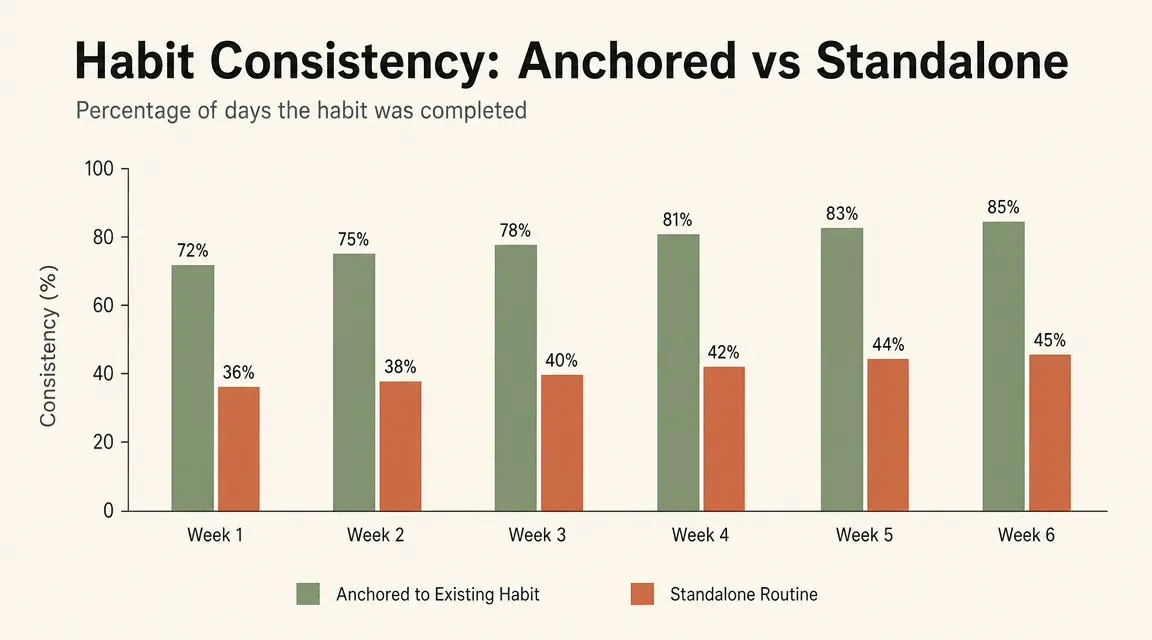
Step 3: Keep the Format Rigidly Simple for the First 30 Days
The Five Minute Journal earns its name. The structure is three gratitudes, one intention for the day, one affirmation in the morning. Three good things and one reflection in the evening. That is the whole format. Resist the urge to expand it during the first month. Do not add freewriting pages, do not supplement with a second journal, do not turn five minutes into twenty.
The reason is simple: you are building the habit of showing up, not the habit of writing beautifully. The prompts do the heavy lifting. You do not have to decide what to write about. You just answer what is in front of you. This matters enormously for mornings that are already fragmented, when the baby woke early or the meeting moved to 7 am. On those mornings, a blank page asks too much. A prompt asks just one thing.
You are building the habit of showing up, not the habit of writing beautifully. The prompts carry you until the ritual can carry itself.
With the Five Minute Journal specifically, the gratitude prompts are worth treating seriously rather than rushing through. The most common failure mode is writing vague, generic entries: 'I am grateful for my health, my family, my home.' That is not wrong, but it is also not particularly useful. The research on gratitude journaling suggests that specificity drives the mood benefit. 'I am grateful for the twenty minutes I sat on the porch before anyone else was awake' lands differently than 'I am grateful for quiet time.' The Five Minute Journal's lined sections are short enough that you are forced to be specific. There is not room to be vague.

Step 4: Build In a Recovery Protocol for Missed Days
You will miss days. A recovery protocol is not a concession to weakness; it is an acknowledgment of reality. The question is not whether you will skip a morning but what you do the next morning. Most people do not decide this in advance, which means the missed day quietly becomes a missed week.
The rule that works: never miss two days in a row. One skip is a rest. Two skips is the beginning of a new habit, and that habit is not journaling. If you miss a morning, leave the page blank rather than skipping it, and fill in a short version that evening: one thing you were grateful for that day. That is the whole recovery entry. It keeps the streak alive without requiring a full session you do not have energy for.
The undated format of the Five Minute Journal is specifically useful here. There is no date printed on the page to remind you that you missed Monday. Each entry exists in its own small space, outside the calendar. That design choice is not accidental. It is built for real life rather than perfect-conditions life.
Step 5: Review Your Entries at the 30-Day Mark
At the end of your first month, read every entry from the beginning. This step is one that most people skip and almost everyone who does it finds valuable. When you read thirty days of gratitude entries in one sitting, patterns emerge that you cannot see while writing them. You notice which people appear repeatedly. You notice which kinds of experiences consistently lift your mood. You notice what you were worrying about in week one that no longer appears in week four.
The Five Minute Journal has a weekly reflection prompt built into its layout, which functions as a smaller version of this practice. But the 30-day read-through is different in character. It is slow. It is retrospective. It shows you the arc of a month in a way that daily entries never can, and it makes the next month feel more intentional because you know more about yourself than you did thirty days ago.
If you practice yoga consistently, you will recognize this as the same principle as periodization: you train for a block, then you assess what the block revealed, then you adjust. The journal review is that assessment moment. It is the part of the practice that tells you whether you are going in the direction you actually want.
What Else Helps This Practice Stick
Physical placement matters more than most people admit. The Five Minute Journal should be on your nightstand or on the table where you have your morning tea, not in a drawer. Out of sight genuinely means out of mind for most rituals. Put it where your eyes land first. Some practitioners keep it on their mat, which enforces the pairing and makes forgetting harder. A pen stored inside the cover eliminates one more small friction point: you do not have to find something to write with, you just open and go.
Lighting and environment play a secondary but real role. The morning ritual that happens at a table with natural light and a warm drink is more sustainable than one that happens in bed, squinting at a phone. This is not about aesthetics. It is about your nervous system receiving consistent cues that this time is intentional. The body learns the ritual as much as the mind does. The Five Minute Journal is small enough to travel easily and works equally well at a kitchen table in Atlanta or a hotel desk in Portland. The ritual moves with you if the cues are simple enough.
For more on what daily gratitude practice actually does to your thinking over time, the article on gratitude journaling and mindset gives a fuller picture. And if you want a deep look at the Five Minute Journal specifically before committing, the long-term review covers what 90 consecutive days actually changes, and what it does not.
Five minutes a morning is not nothing. Over 90 days it is six hours of intentional practice.
The Five Minute Journal by Intelligent Change has 17,539 reviews and a 4.5-star rating. It is structured, undated, and takes less time than a cup of tea. If you are building a morning ritual around yoga and mindfulness, this is the lowest-friction way to add a gratitude practice that actually compounds.
Amazon Check Today's Price on Amazon →